
STAINLESS STEEL GRADE
SUS 201 and SUS 202 Stainless Steel
SUS 201 and SUS 202 are chromium-manganese-nickel austenitic stainless steels belonging to the 200 series. They use manganese and nitrogen to replace part of the nickel found in conventional chromium-nickel grades such as SUS 304.
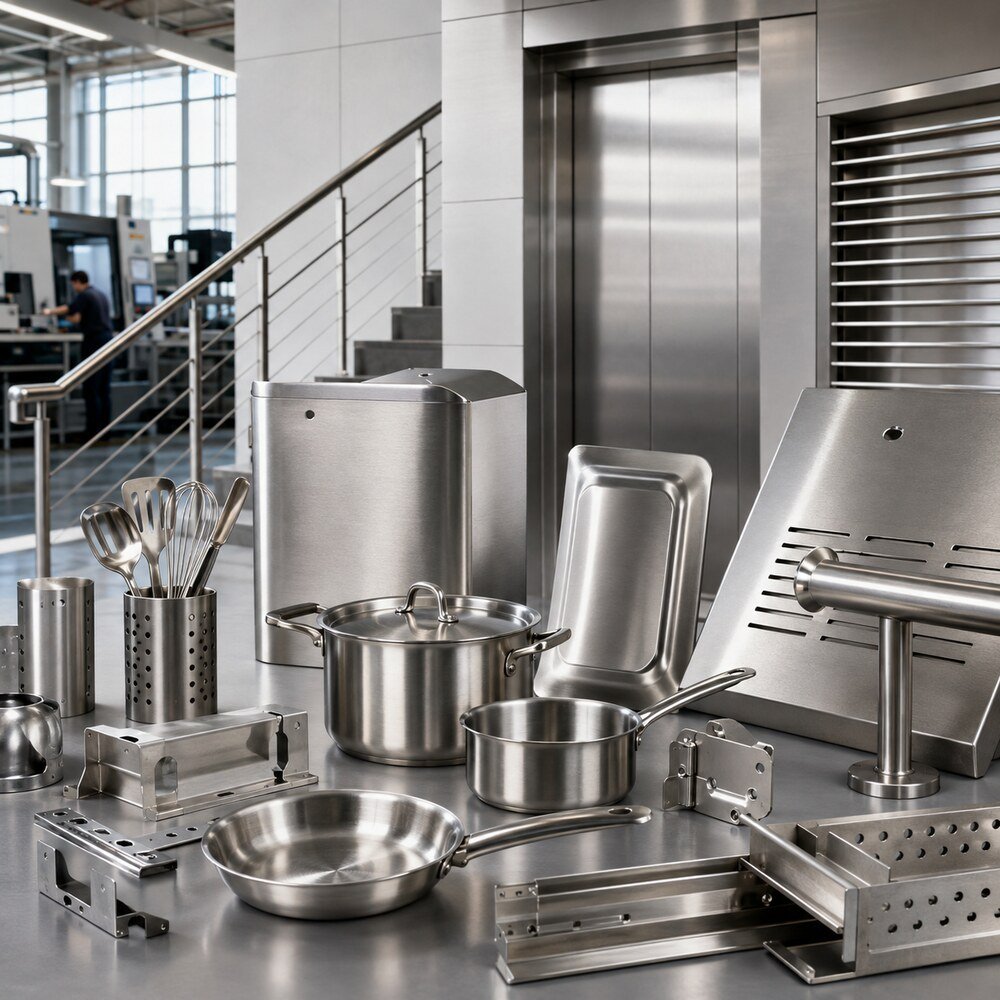
Both grades provide useful strength, formability, wear resistance, and corrosion resistance for compatible indoor and mildly corrosive applications. They are commonly evaluated for kitchenware, household appliances, sinks, decorative components, transportation equipment, fabricated products, and precision-stamped parts.
However, SUS 201 and SUS 202 should not automatically be treated as lower-cost replacements for SUS 304. Their suitability depends on corrosion exposure, forming requirements, welding, required appearance, service temperature, and applicable product standards.
MATERIAL INTRODUCTION
What Is SUS 201 Stainless Steel?
SUS 201 is a low-nickel, chromium-manganese-nitrogen austenitic stainless steel. Its relatively high manganese and nitrogen content provides strength and helps stabilize the austenitic structure while reducing dependence on nickel.
SUS 201 exhibits high work hardening during cold forming. This characteristic can provide high strength in cold-worked strip and sheet, but it also requires suitable tooling and forming procedures.
SUS 201 is broadly associated with Type 201, UNS S20100, EN 1.4372, and the EN name X12CrMnNiN17-7-5. Outokumpu identifies it as an austenitic low-nickel grade used for household appliances, kitchen utensils, sinks, doors, windows, and railroad cars. Outokumpu
MATERIAL INTRODUCTION
What Is SUS 202 Stainless Steel?
SUS 202 is another chromium-manganese-nickel austenitic stainless steel. Compared with SUS 201, it generally contains more manganese, chromium, and nickel.
These compositional differences can provide useful strength, formability, and corrosion resistance in compatible service environments. Typical applications include kitchen utensils, appliance components, decorative parts, architectural trim, equipment housings, and general fabricated products.
SUS 202 is broadly associated with Type 202, UNS S20200, EN 1.4373, and X12CrMnNiN18-9-5.
Equivalent Grades
SUS 201 and SUS 202 are chromium-manganese-nickel austenitic stainless steels belonging to the 200 series. The following designations are broadly comparable across commonly referenced international standards.
| Standard or System | SUS 201 | SUS 202 |
|---|---|---|
| JIS | SUS 201 | SUS 202 |
| AISI | Type 201 | Type 202 |
| ASTM / UNS | Type 201 / S20100 | Type 202 / S20200 |
| EN Material Number | 1.4372 | 1.4373 |
| EN Steel Name | X12CrMnNiN17-7-5 | X12CrMnNiN18-9-5 |
Equivalency note: Equivalent designations are broadly comparable but are not automatically interchangeable. Chemical limits, mechanical requirements, product dimensions, testing, tolerances, surface conditions, and certification may vary by standard and product form. Confirm compliance using the governing specification and material test certificate.
Key Characteristics of SUS 201 & SUS 202
SUS 201 and SUS 202 are low-nickel chromium-manganese austenitic stainless steels. Both provide high strength, good formability, and strong work-hardening behavior. SUS 201 contains less manganese, chromium, and nickel, while SUS 202 generally contains higher levels of these alloying elements.
Low-Nickel Austenitic Structure
Both grades use manganese and nitrogen to replace part of the nickel used in conventional chromium-nickel austenitic stainless steels.
Approximately 3.5–5.5% nickel and 5.5–7.5% manganese.
Approximately 4–6% nickel and 7.5–10.5% manganese.
High Mechanical Strength
Nitrogen and manganese contribute to useful strength in the annealed condition. Both grades can achieve substantially higher strength through cold rolling or other work-hardening processes.
Frequently selected for high-strength and work-hardened components.
Provides high strength with a slightly different alloy balance.
Strong Work-Hardening Response
Strength and hardness increase rapidly during rolling, drawing, stamping, and forming. Ductility decreases as the amount of cold work increases.
Known for a particularly strong work-hardening response.
Also work hardens significantly during cold fabrication.
Good Formability
Both grades can be bent, stamped, drawn, rolled, and formed into complex parts. Tooling, lubrication, forming speed, bend radius, and material condition should account for their rapid work hardening.
Common in sinks, stamped parts, housings, and transportation components.
Common in utensils, appliance parts, decorative products, and fabricated components.
Suitable Weldability
SUS 201 and SUS 202 can be welded using common stainless steel welding methods. Appropriate filler material, shielding, heat control, cleaning, and post-weld surface treatment may be required.
Welding procedures should account for its high work-hardening behavior.
Requires compatible procedures based on thickness and service conditions.
Moderate Corrosion Resistance
Both grades perform well in many dry, indoor, and mildly corrosive environments. Neither should automatically be substituted for SUS 304 in wet, coastal, chloride-rich, or chemically aggressive service.
Contains approximately 16–18% chromium.
Contains approximately 17–19% chromium but is still below SUS 304 in many corrosive environments.
Maintainable Surface Finishes
Depending on mill and product availability, both grades may be supplied in 2B, BA, No.3, No.4, hairline, polished, and application-specific decorative finishes.
Widely used for indoor decorative and visible components.
Suitable for decorative products where the environment is compatible.
Variable Magnetic Response
Annealed SUS 201 and SUS 202 may be non-magnetic or weakly magnetic. Cold rolling, forming, stamping, machining, or welding can create a stronger magnetic response.
Cold working can produce a noticeable magnetic response.
Magnetic response also depends on composition and processing history.
Selection note: Nominal grade differences do not replace the material test certificate. Final performance depends on certified chemistry, product form, thickness, surface finish, processing condition, fabrication method, and actual service environment.
SUS 201 & SUS 202 Chemical Composition
SUS 201 and SUS 202 are low-nickel chromium-manganese austenitic stainless steels. SUS 202 generally contains more manganese, chromium, and nickel, while both grades use nitrogen to provide strength and help stabilize the austenitic structure.
| Element | SUS 201 / S20100 | SUS 202 / S20200 | ||
|---|---|---|---|---|
| Minimum | Maximum | Minimum | Maximum | |
| Carbon (C) | — | 0.15% | — | 0.15% |
| Silicon (Si) | — | 1.00% | — | 1.00% |
| Manganese (Mn) | 5.50% | 7.50% | 7.50% | 10.00% |
| Phosphorus (P) | — | 0.060% | — | 0.060% |
| Sulfur (S) | — | 0.030% | — | 0.030% |
| Chromium (Cr) | 16.00% | 18.00% | 17.00% | 19.00% |
| Nickel (Ni) | 3.50% | 5.50% | 4.00% | 6.00% |
| Nitrogen (N) | — | 0.25% | — | 0.25% |
| Iron (Fe) | Balance | Balance | Balance | Balance |
Values shown are commonly referenced ASTM/UNS composition limits. EN 1.4372 and EN 1.4373 commonly specify nitrogen at 0.05–0.25%, phosphorus at 0.045% maximum, and sulfur at 0.015% maximum. EN 1.4373 may permit manganese up to 10.50%. Do not combine limits from different standards into a single compliance claim. Final requirements should follow the purchase specification and material test certificate.
SUS 201 & SUS 202 Mechanical Properties
SUS 201 and SUS 202 provide useful strength and ductility in the annealed condition. Both grades work harden rapidly during cold rolling, drawing, stamping, and forming, allowing substantially higher strength to be achieved in cold-worked products.
| Mechanical Property | SUS 201 / S20100 | SUS 202 / S20200 | Unit or Condition |
|---|---|---|---|
| 0.2% Proof Strength | ≥260 | ≥275 | MPa (N/mm²) |
| Tensile Strength | ≥655 | ≥515 | MPa (N/mm²) |
| Elongation | ≥40 | ≥40 | % |
| Rockwell Hardness | ≤100 | ≤95 | HRB |
Values shown are commonly cited reference values for annealed products and should not be interpreted as universal requirements. JIS, ASTM, and EN standards may specify different minimum strengths, tensile ranges, elongation values, or hardness limits according to product form and thickness. Cold-worked material can provide much higher strength and hardness with lower ductility. Final acceptance should follow the governing specification and material test certificate.
Physical Properties of SUS 201 & SUS 202
SUS 201 and SUS 202 have broadly similar physical properties because both belong to the chromium-manganese austenitic stainless steel family. Their thermal expansion and thermal conductivity are generally comparable to other austenitic stainless steels.
| Physical Property | SUS 201 | SUS 202 | Unit or Condition |
|---|---|---|---|
| Density | Approx. 7.8 | Approx. 7.8 | g/cm³ |
| Elastic Modulus | Approx. 197–200 | Approx. 200–207 | GPa |
| Thermal Conductivity | Approx. 15–16 | Approx. 15–16 | W/m·K at room temperature |
| Specific Heat Capacity | Approx. 500 | Approx. 500 | J/kg·K |
| Mean Thermal Expansion | Approx. 16–17 | Approx. 16–17 | µm/m·K |
| Electrical Resistivity | Approx. 0.69 | Approx. 0.70 | µΩ·m at room temperature |
| Annealed Magnetic Response | Non-magnetic to weakly magnetic | Non-magnetic to weakly magnetic | Cold working may increase magnetism |
Values are approximate room-temperature references and may vary with chemical composition, material condition, product form, temperature, and testing method. Cold rolling, forming, stamping, machining, or welding can increase the magnetic response of both grades. Use the applicable specification and supplier documentation when physical-property values are required for engineering calculations.
SUS 201 VS SUS 202
SUS 201 and SUS 202 are chromium-manganese-nickel austenitic stainless steels with high strength and strong work-hardening behavior. SUS 201 generally contains less manganese, chromium, and nickel, while SUS 202 uses higher alloy levels and a different balance of strength, formability, cost, and corrosion performance.
| Feature | SUS 201 | SUS 202 |
|---|---|---|
| Stainless Steel Family | Austenitic chromium-manganese-nickel stainless steel | Austenitic chromium-manganese-nickel stainless steel |
| UNS Designation | S20100 | S20200 |
| EN Designation | 1.4372 / X12CrMnNiN17-7-5 | 1.4373 / X12CrMnNiN18-9-5 |
| Chromium Content | Approximately 16–18% | Approximately 17–19% |
| Nickel Content | Approximately 3.5–5.5% | Approximately 4–6% |
| Manganese Content | Approximately 5.5–7.5% | Approximately 7.5–10.5% |
| Annealed Strength | Generally high, with commonly referenced tensile requirements around 655 MPa or higher | High, although the required value depends strongly on the governing standard and product form |
| Work-Hardening Response | Particularly strong; develops high strength rapidly during cold working | Strong work-hardening response during rolling, forming, and stamping |
| Formability | Good, but tooling and forming procedures must account for rapid work hardening | Good for drawing, stamping, and forming when suitable procedures are used |
| Weldability | Suitable with appropriate stainless steel welding procedures | Suitable with appropriate stainless steel welding procedures |
| General Corrosion Resistance | Moderate; suitable for many indoor and mildly corrosive environments | Moderate; its higher chromium content may provide an advantage in some conditions, but performance remains application-dependent |
| Magnetic Response | Non-magnetic to weakly magnetic when annealed; cold working can increase magnetism | Non-magnetic to weakly magnetic when annealed; cold working can increase magnetism |
| Typical Applications | Sinks, kitchenware, appliances, transportation components, architectural trim, housings, and precision-stamped parts | Utensils, appliances, decorative components, equipment housings, fabricated products, and architectural parts |
| Common Selection Reason | High strength and strong work hardening with reduced dependence on nickel | Balanced 200-series performance with higher chromium, manganese, and nickel content |
Selection note: SUS 202 is not automatically superior to SUS 201, and neither grade should automatically replace SUS 304. The correct choice depends on certified chemistry, mechanical requirements, forming severity, welding, surface appearance, chloride exposure, cleaning chemicals, product form, and service environment. Confirm the final selection using the governing specification and material test certificate.
Corrosion and Oxidation Resistance of SUS 201 & SUS 202
SUS 201 and SUS 202 form passive chromium-oxide surface layers that provide moderate corrosion and oxidation resistance in compatible environments. Both grades are best suited to indoor, dry, and mildly corrosive applications. They generally provide less environmental tolerance than SUS 304, especially when exposed to moisture, chlorides, salt, or aggressive cleaning chemicals.
General Corrosion Resistance
Both grades provide useful resistance to atmospheric corrosion in clean, indoor environments. Proper surface finish, fabrication, cleaning, drainage, and maintenance are important to long-term performance.
Contains approximately 16–18% chromium and is commonly selected for compatible indoor and decorative applications.
Contains approximately 17–19% chromium and may provide an advantage in some environments, but performance remains application-dependent.
Oxidation Resistance
SUS 201 and SUS 202 offer useful oxidation resistance at moderately elevated temperatures. However, neither grade should be selected for continuous high-temperature service based only on its chromium content.
- Temperature limits depend on loading and exposure duration
- Repeated thermal cycling can affect dimensional stability
- Combustion gases and deposits may accelerate surface degradation
- Welds and cold-worked areas may behave differently from base metal
Commonly Suitable Environments
SUS 201 and SUS 202 are frequently evaluated for products used in controlled indoor environments with limited chloride exposure.
- Indoor kitchenware and household products
- Appliance panels, housings, and internal components
- Interior architectural and decorative trim
- Furniture, cabinets, and equipment enclosures
- Transportation interiors and fabricated components
- Precision-stamped parts used in compatible environments
Important Corrosion Limitations
Neither grade is automatically suitable for environments involving persistent moisture, salts, aggressive chemicals, or poor drainage.
- Marine and coastal atmospheric exposure
- Continuous outdoor wetting or immersion
- Saltwater and high-chloride solutions
- Hydrochloric acid and strong reducing acids
- Chloride-containing cleaners and disinfectants
- Poorly drained joints, deposits, and crevices
Maintaining Corrosion Resistance
Correct processing and maintenance help protect the passive surface and reduce staining, contamination, and localized corrosion.
- Avoid contamination from carbon-steel tools and grinding dust
- Remove fabrication residues and weld discoloration when required
- Use cleaning products compatible with 200-series stainless steel
- Rinse away chloride-containing residues and cleaning chemicals
- Prevent trapped moisture and poorly drained crevices
- Establish an appropriate cleaning and inspection schedule
When to Select Another Grade
A higher-alloy grade should be considered when corrosion resistance and long-term appearance are more important than initial material cost.
- Consider SUS 304 for broader general corrosion resistance
- Consider SUS 316L for improved chloride resistance
- Use higher-alloy materials for severe chemical environments
- Perform application-specific testing when conditions are uncertain
Selection note: The higher chromium content of SUS 202 does not automatically make it suitable for every environment or universally superior to SUS 201. Corrosion and oxidation performance also depend on actual mill chemistry, surface finish, temperature, humidity, chlorides, fabrication, deposits, cleaning chemicals, and maintenance. Confirm the final grade using the governing specification and material test certificate.
SUS 201 & SUS 202 Stainless Steel Applications
SUS 201 and SUS 202 are commonly used for indoor, decorative, structural, and fabricated products requiring high strength, good formability, and moderate corrosion resistance. Their suitability should be confirmed against the actual moisture, chloride, chemical, forming, and maintenance conditions.
Kitchenware and Household Products
Common applications include bowls, trays, utensils, cookware components, sinks, storage products, and other formed household items used in compatible environments.
Frequently used for sinks, bowls, trays, and deep-drawn household products requiring high strength.
Commonly evaluated for utensils, cookware components, containers, and decorative household products.
Household and Commercial Appliances
Applications include appliance panels, cabinets, internal components, covers, housings, brackets, and fabricated parts used in dry or mildly corrosive service.
Suitable for high-strength panels, housings, brackets, and stamped appliance components.
Suitable for appliance covers, cabinets, visible components, and general fabricated parts.
Architectural and Decorative Components
Both grades can be used for indoor wall panels, elevator trim, doors, window components, signs, railings, fixtures, and decorative surfaces.
Common for indoor trim, structural decoration, doors, windows, and high-strength formed components.
Common for visible panels, decorative products, fixtures, and architectural components in controlled environments.
Transportation Equipment
Applications include railroad-car interiors, vehicle trim, panels, equipment covers, enclosures, brackets, and selected fabricated structural parts.
Its high strength and work-hardening capacity support railroad, vehicle, and transportation components.
May be used for trim, panels, housings, and general transportation components with compatible service requirements.
Precision Stamping and Formed Parts
SUS 201 and SUS 202 can be processed into clips, clamps, covers, brackets, retainers, springs, and other stamped or roll-formed components.
Particularly useful where strong work hardening and high cold-worked strength are required.
Suitable for formed and stamped components requiring balanced strength and ductility.
Furniture and Commercial Equipment
Typical uses include furniture frames, shelving, cabinets, counters, equipment housings, display fixtures, enclosures, and storage systems.
Often selected for high-strength frames, supports, cabinets, and structural furniture components.
Often evaluated for decorative furniture, equipment panels, cabinets, and general-purpose fabricated products.
Industrial Equipment and Enclosures
Both grades may be used for control cabinets, machine covers, equipment enclosures, guards, panels, containers, and general fabricated components in compatible indoor environments.
Suitable where high strength and resistance to mechanical deformation are important.
Suitable for general enclosures, covers, panels, and fabricated equipment components.
Products Requiring Decorative Finishes
Depending on availability, SUS 201 and SUS 202 may be supplied with 2B, BA, No.3, No.4, hairline, polished, and other application-specific surface finishes.
Common in cost-sensitive visible products used in controlled indoor environments.
Suitable for decorative products when appearance and environmental requirements match the grade’s corrosion resistance.
Application note: Neither grade should automatically replace SUS 304 in coastal, continuously wet, chloride-rich, food-processing, pharmaceutical, or chemically aggressive environments. Final selection should consider the certified composition, material condition, forming requirements, welding, surface finish, cleaning chemicals, maintenance, and governing specification.
faq
Stainless Steel SUS 201 & SUS 202
These frequently asked questions explain the differences, properties, corrosion resistance, fabrication, and common applications of SUS 201 and SUS 202 stainless steel.
What are SUS 201 and SUS 202 stainless steel?
SUS 201 and SUS 202 are chromium-manganese-nickel austenitic stainless steels belonging to the 200 series. Manganese and nitrogen replace part of the nickel used in conventional chromium-nickel grades, providing high strength, good formability, and strong work-hardening behavior.
What is the main difference between SUS 201 and SUS 202?
SUS 201 typically contains approximately 16–18% chromium, 3.5–5.5% nickel, and 5.5–7.5% manganese. SUS 202 generally contains approximately 17–19% chromium, 4–6% nickel, and 7.5–10.5% manganese. Actual performance depends on certified chemistry, material condition, product form, and service environment.
Which is better, SUS 201 or SUS 202?
Neither grade is universally better. SUS 201 is frequently selected for high strength and strong work hardening. SUS 202 contains somewhat higher chromium, manganese, and nickel, but this does not automatically make it superior in every application. Selection should be based on forming, strength, corrosion exposure, availability, and cost.
Can SUS 201 or SUS 202 replace SUS 304?
Not automatically. SUS 201 and SUS 202 may be suitable for indoor and mildly corrosive applications, but SUS 304 generally provides better overall corrosion resistance and more consistent performance in wet, outdoor, food-processing, or chemically exposed environments.
Do SUS 201 and SUS 202 rust?
Both grades are corrosion-resistant stainless steels, but they can stain or corrode when exposed to persistent moisture, salt, chlorides, aggressive cleaners, chemical contamination, or poorly drained crevices. Proper grade selection, fabrication, cleaning, and maintenance are essential.
Are SUS 201 and SUS 202 magnetic?
Annealed SUS 201 and SUS 202 may be non-magnetic or weakly magnetic. Cold rolling, stamping, drawing, machining, and welding can transform part of the structure and create a stronger magnetic response. Magnetism alone is not a reliable method of identifying the grade.
Can SUS 201 and SUS 202 be welded?
Yes. Both grades can be welded using suitable stainless steel welding processes. The welding procedure should specify compatible filler materials, shielding, heat input, joint preparation, cleaning, and post-weld surface treatment according to the product and service environment.
Are SUS 201 and SUS 202 suitable for food equipment?
Suitability depends on the food, temperature, cleaning chemicals, sanitation requirements, surface finish, and applicable regulations. SUS 304 or SUS 316L is often preferred for demanding food-processing equipment because of its broader corrosion resistance. Compliance should be confirmed for the specific application.
Are SUS 201 and SUS 202 suitable for outdoor use?
They may perform acceptably in sheltered, low-pollution environments, but they are not normally the first choice for coastal, industrial, chloride-contaminated, or continuously wet outdoor exposure. Surface staining and localized corrosion risks should be evaluated before use.
What are the common applications of SUS 201 and SUS 202?
Typical applications include kitchenware, sinks, household appliances, indoor decorative panels, furniture, cabinets, equipment housings, transportation interiors, architectural trim, containers, and precision-stamped components used in compatible environments.
Why do SUS 201 and SUS 202 become harder during forming?
Both grades have a strong work-hardening response. Cold rolling, drawing, bending, or stamping increases their strength and hardness while reducing ductility. Tooling, lubrication, forming speed, bend radius, and intermediate annealing should be considered for demanding forming operations.
How can buyers verify SUS 201 and SUS 202 material?
Buyers should request a material test certificate showing the grade, heat number, chemical composition, mechanical properties, product form, dimensions, material condition, and governing standard. Positive material identification may also be required for critical projects.
Technical information is provided for general comparison. Final material selection should follow the governing specification, regulatory requirements, fabrication conditions, service environment, and material test certificate.
Take Action