
STAINLESS STEEL GRADE
SUS 304L Stainless Steel
SUS 304L is a low-carbon austenitic stainless steel developed for applications involving welding and exposure to corrosive service conditions. It combines good general corrosion resistance, excellent formability, reliable weldability, and strong low-temperature toughness.
The “L” designation means low carbon. By limiting carbon content to approximately 0.03% maximum, SUS 304L reduces the formation of chromium carbides in heat-affected areas during welding. This helps preserve corrosion resistance around welded joints and makes the grade especially suitable for tanks, piping, food-processing equipment, chemical equipment, architectural components, and other welded assemblies.
SUS 304L is commonly associated with AISI 304L, ASTM Type 304L, UNS S30403, and EN 1.4307. Final material requirements should always be verified against the specified standard, product form, and Mill Test Certificate.
MATERIAL INTRODUCTION
SUS 304L Stainless Steel Overview
SUS 304L is the low-carbon version of SUS 304 stainless steel. It contains approximately 18% chromium and 8% nickel, providing the austenitic structure, corrosion resistance, ductility, and fabrication performance associated with the 300-series stainless steel family.
Its principal advantage is not substantially greater corrosion resistance in every environment. Instead, SUS 304L is designed to better maintain corrosion resistance after welding by reducing the risk of sensitization and intergranular corrosion in heat-affected areas.
For this reason, SUS 304L is frequently specified for welded tanks, piping systems, process equipment, architectural assemblies, food-processing equipment, and components that cannot be conveniently solution annealed after fabrication.
The Nickel Institute describes 304L as the low-carbon version that maintains corrosion resistance after welding. Nickel Institute
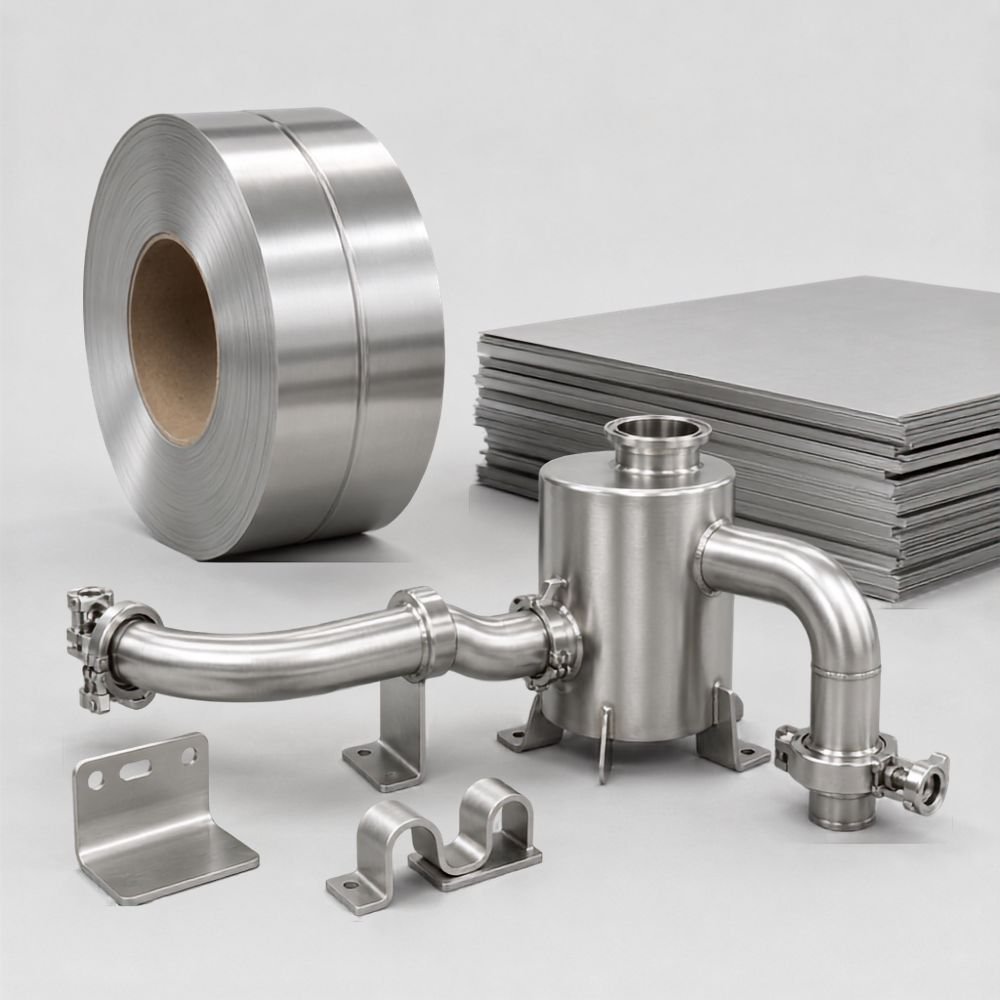
SUS 304L Equivalent Grades
| Standard | Grade Designation |
|---|---|
| JIS | SUS 304 |
| AISI | 304 |
| ASTM / UNS | Type 304 / S30400 |
| EN | 1.4301 |
| EN Name | X5CrNi18-10 |
Equivalent grade names may vary by regional standards and customer specifications. Final material confirmation should be based on the applicable standard, mill certificate, and order requirements.
What Is SUS 304L Stainless Steel?
SUS 304L is an austenitic chromium-nickel stainless steel with a maximum carbon content generally limited to 0.03%. It was developed to reduce the possibility of chromium-carbide precipitation when stainless steel is exposed to certain temperatures during welding or fabrication.
When chromium carbides form at grain boundaries, nearby areas can become depleted in chromium. This condition is known as sensitization and may reduce resistance to intergranular corrosion.
The lower carbon content of SUS 304L reduces this risk, allowing welded components to retain better corrosion performance without requiring post-weld solution annealing in many general applications.
SUS 304L is therefore commonly selected when a component:
- Requires extensive welding
- Contains heavy or complex welded sections
- Cannot be heat-treated after welding
- May encounter corrosion around welded joints
- Requires good formability and cleanability
- Operates at low or moderately elevated temperatures
SUS 304L is not automatically suitable for every corrosive environment. Chloride concentration, temperature, chemical exposure, fabrication quality, surface finish, and equipment design must still be evaluated.
Key Characteristics of SUS 304L
Low Carbon for Welded Fabrication
The carbon content of SUS 304L is generally limited to 0.03% maximum. This reduces chromium-carbide precipitation during welding and helps preserve corrosion resistance in heat-affected zones.
Good General Corrosion Resistance
SUS 304L performs well in many atmospheric, freshwater, food-processing, mildly chemical, and indoor industrial environments. Its chromium content supports the formation of a passive oxide layer that protects the underlying steel.
Excellent Weldability
SUS 304L is readily welded using common stainless steel welding processes. Its low carbon content makes it particularly useful for fabricated tanks, piping, enclosures, frames, and process equipment containing multiple welded joints.
Excellent Formability
The grade can be bent, rolled, stamped, drawn, and formed into complex parts. Typical products include containers, kitchen equipment, architectural panels, appliance components, covers, tanks, and precision-fabricated assemblies.
Strong Low-Temperature Toughness
As an austenitic stainless steel, SUS 304L retains good ductility and toughness at low and cryogenic temperatures. It is used in selected low-temperature storage, processing, and transportation equipment.
Clean and Maintainable Surface
SUS 304L can be supplied in No.1, 2B, BA, No.3, No.4, hairline, polished, and other decorative or functional surface finishes.
Generally Non-Magnetic When Annealed
Annealed SUS 304L is generally non-magnetic or only weakly magnetic. Cold working, forming, machining, and welding can produce some magnetic response.
SUS 304L Chemical Composition
| Element | Symbol | Minimum (wt.%) | Maximum (wt.%) |
|---|---|---|---|
| Carbon | C | — | 0.030 |
| Silicon | Si | — | 1.00 |
| Manganese | Mn | — | 2.00 |
| Phosphorus | P | — | 0.045 |
| Sulfur | S | — | 0.030 |
| Chromium | Cr | 18.00 | 20.00 |
| Nickel | Ni | 9.00 | 13.00 |
| Iron | Fe | Balance | |
Composition limits may vary according to the applicable JIS, ASTM, EN, or customer specification. Final values should be verified using the governing standard and the material’s Mill Test Certificate.
SUS 304L Mechanical Properties
| Mechanical Property | Common Reference Value |
|---|---|
| 0.2% Proof Strength | ≥175 MPa |
| Tensile Strength | ≥480 MPa |
| Elongation | ≥40% |
| Rockwell Hardness | ≤90 HRB |
| Vickers Hardness | ≤200 HV |
These are common reference values for annealed SUS 304L flat products. Actual requirements vary according to the applicable standard, product form, thickness, heat treatment, and manufacturing condition. Cold working can increase strength and hardness while reducing elongation.
Physical Properties of SUS 304L
| Physical Property | Typical Value |
|---|---|
| Density | Approximately 7.9–8.0 g/cm³ |
| Elastic Modulus | Approximately 193 GPa |
| Thermal Conductivity at Room Temperature | Approximately 16.2 W/m·K |
| Specific Heat | Approximately 500 J/kg·K |
| Mean Thermal Expansion | Approximately 17.2 µm/m·K |
| Electrical Resistivity | Approximately 0.72 µΩ·m |
| Magnetic Behavior | Generally non-magnetic when annealed; may become partially magnetic after cold working, forming, machining, or welding |
These values are typical references and may vary according to temperature, product form, processing condition, and test method.
SUS 304 vs. SUS 304L
| Feature | SUS 304 | SUS 304L |
|---|---|---|
| Carbon Content | Standard low-carbon range | Lower carbon, commonly ≤ 0.03% |
| General Corrosion Resistance | Good | Similar in many environments |
| Welding Performance | Good | Better resistance to weld-related sensitization |
| High-Temperature Strength | Generally better than 304L | May be more limited in some high-temperature applications |
| Common Selection Reason | General fabrication and broad availability | Welded structures and corrosion-sensitive welded components |
SUS 304 and SUS 304L are closely related stainless steel grades. Final material selection should be based on welding requirements, corrosion environment, operating temperature, fabrication method, and applicable material standards.
SUS 304L vs. SUS 316L
| Feature | SUS 304L | SUS 316L |
|---|---|---|
| Main Alloy System | Chromium-nickel | Chromium-nickel-molybdenum |
| Carbon Content | Low carbon, commonly ≤0.03% | Low carbon, commonly ≤0.03% |
| General Corrosion Resistance | Good in many general environments | Very good in more demanding environments |
| Chloride Resistance | Moderate | Better than SUS 304L |
| Weldability | Excellent | Excellent |
| Pitting and Crevice Corrosion | More vulnerable in chloride-rich conditions | Better resistance due to molybdenum |
| Coastal or Marine Exposure | Requires careful evaluation | Usually preferred over SUS 304L |
| Typical Material Cost | Generally lower | Generally higher |
| Common Applications | Food equipment, welded tanks, architectural components, appliances, and general process equipment | Marine equipment, chemical processing, pharmaceutical equipment, coastal structures, and chloride-exposed systems |
| Common Selection Reason | Cost-effective low-carbon grade for welded fabrication in compatible environments | Higher resistance to chlorides and localized corrosion |
The “L” designation indicates low carbon; it does not indicate increased chloride resistance. Final grade selection should consider chloride concentration, chemical exposure, operating temperature, fabrication method, cleaning process, and service environment.
Corrosion Resistance of SUS 304L
SUS 304L offers good corrosion resistance across many general industrial and commercial environments. Its low carbon content is particularly beneficial where welded joints could otherwise become vulnerable to intergranular corrosion.
SUS 304L is frequently used in:
- Indoor and sheltered architectural applications
- Freshwater and normal humid environments
- Food and beverage processing
- Commercial kitchens and catering equipment
- Mild oxidizing and alkaline environments
- General chemical-processing equipment
- Welded tanks and piping
- Low-temperature processing equipment
- Clean industrial and laboratory environments
SUS 304L may not provide adequate resistance in:
- Seawater and marine environments
- Coastal areas with heavy salt deposits
- Chloride-rich process fluids
- Swimming-pool environments
- Hydrochloric acid service
- Hot chloride-containing solutions
- Poorly drained crevices
- Highly reducing acids
- Contaminated or improperly cleaned surfaces
In chloride-rich environments, localized pitting, crevice corrosion, and chloride stress-corrosion cracking can occur. SUS 316L, duplex stainless steel, or a higher-alloy material may be required depending on concentration, temperature, stress, and exposure duration.
SUS 304L Stainless Steel Applications
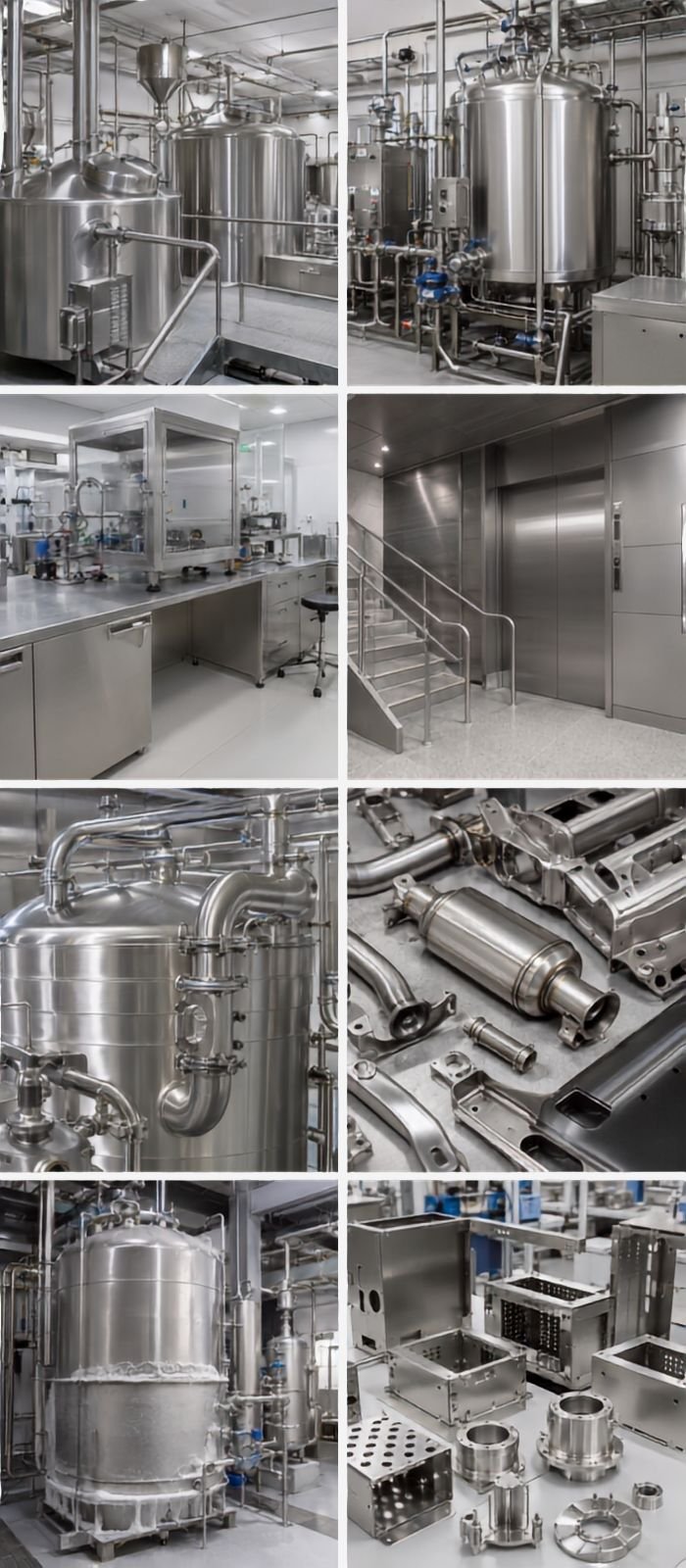
Food and Beverage Processing
SUS 304L is used for welded tanks, food-processing machinery, brewing equipment, dairy equipment, mixing vessels, storage containers, work surfaces, piping, and commercial kitchen systems.
Its cleanability and general corrosion resistance make it suitable for many hygienic processing environments, subject to the food chemistry and cleaning procedure.
Chemical and Process Equipment
Common applications include welded storage tanks, process vessels, piping, enclosures, covers, valves, and instrument components used with compatible chemicals.
Material suitability must be evaluated according to chemical concentration, temperature, pressure, contamination, and cleaning conditions.
Pharmaceutical and Laboratory Equipment
SUS 304L may be used for equipment housings, work surfaces, containers, laboratory fixtures, clean-process components, and selected welded assemblies.
Critical pharmaceutical applications may require stricter surface, documentation, validation, and material-grade requirements.
Architectural and Construction Components
Applications include welded handrails, interior panels, elevator components, doors, frames, decorative structures, building hardware, and architectural trim.
For coastal or chloride-exposed buildings, SUS 316L or another more corrosion-resistant grade may be preferable.
Tanks, Vessels, and Piping Systems
The low carbon content makes SUS 304L particularly useful for fabricated tanks, piping systems, pressure-related components, and vessels containing multiple welded joints.
Pressure applications must comply with the relevant engineering, design, fabrication, inspection, and certification standards.
Automotive and Transportation
SUS 304L can be used in formed parts, brackets, clamps, exhaust-related assemblies, transportation containers, equipment housings, and welded structures.
Cryogenic and Low-Temperature Equipment
Its austenitic structure provides good toughness at low temperatures, making SUS 304L suitable for selected cryogenic storage, transportation, and processing applications.
Electronics and Precision Manufacturing
Applications include equipment enclosures, clean-process components, precision-stamped parts, covers, brackets, instrument components, and fabricated assemblies.
faq
Stainless Steel CSP Material FAQ
The “L” means low carbon. SUS 304L generally contains no more than approximately 0.03% carbon, reducing the risk of chromium-carbide precipitation during welding.
Not in every application. SUS 304L is generally preferred for extensively welded or corrosion-sensitive fabricated components. SUS 304 may provide better strength in certain elevated-temperature applications.
Their general corrosion resistance is similar in many environments. SUS 304L’s primary advantage is its improved ability to retain corrosion resistance around welded areas by reducing sensitization.
SUS 304L is generally not the preferred grade for seawater or aggressive chloride exposure. SUS 316L, duplex stainless steel, or a higher-alloy grade may be more appropriate.
Take Action