
MATERIAL PERFORMANCE FOR DEMANDING OPERATING ENVIRONMENTS
Stainless Steel for Chemical & Industrial Equipment
Genn-Hann supplies stainless steel coil, sheet and precision strip for tanks, equipment enclosures, process machinery, heat-transfer components, material-handling systems and general industrial fabrication. Customized grades, dimensions and surface finishes support equipment requiring corrosion resistance, mechanical durability and consistent downstream processing.
Industry Introduction
Why Stainless Steel Is Used in Chemical and Industrial Equipment
Stainless steel is used across chemical processing and industrial manufacturing because it combines corrosion resistance, mechanical strength, cleanability and fabrication versatility. It can be cut, formed, welded and finished into equipment components exposed to chemicals, moisture, heat, pressure and repeated production cycles.
Material suitability depends on the specific chemical medium, concentration, temperature, pressure, flow conditions, contaminants, cleaning procedure and equipment design. Stainless steel grade selection must therefore be based on documented operating conditions rather than a general assumption of chemical resistance.
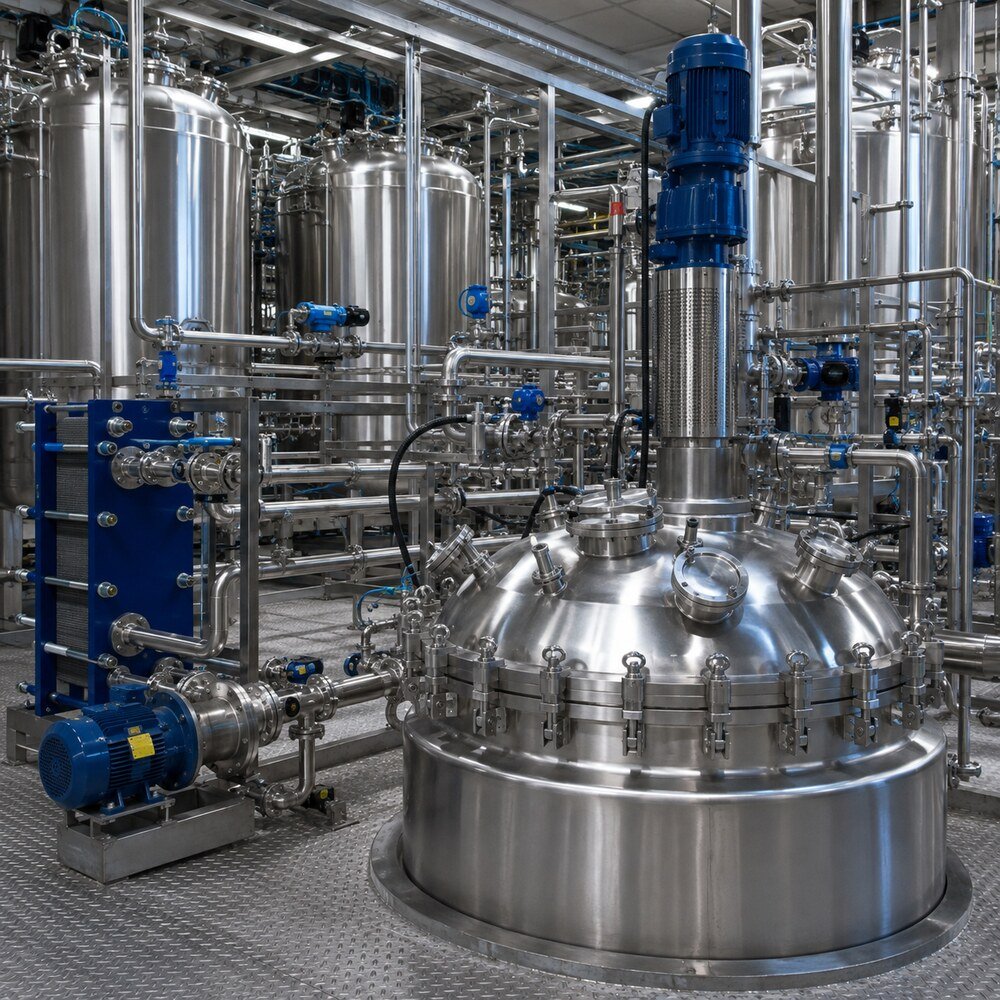
FROM PROCESS EQUIPMENT TO INDUSTRIAL INFRASTRUCTURE
Stainless Steel Applications for Chemical and Industrial Equipment
SELECT GRADES ACCORDING TO CHEMICAL EXPOSURE AND OPERATING CONDITIONS
Stainless Steel Grades for Chemical and Industrial Equipment
Material selection should consider the chemical medium, concentration, temperature, pressure, flow conditions, contaminants, fabrication method and cleaning procedure. SUS 304 and 316L support many general industrial applications, while ferritic and precision-strip grades may be considered for selected structural, thermal or formed components.
| Stainless Steel Grade | Recommended Positioning | Grade Details |
|---|---|---|
| SUS 304 / 304L | A versatile option for general industrial tanks, equipment panels, cabinets, guards, hoppers, frames and fabricated components used with compatible chemicals and operating environments. The low-carbon 304L grade may be preferred for welded fabrication. | |
| SUS 316 / 316L | Considered for components exposed to more demanding chemical, chloride-containing or humid industrial environments. Molybdenum improves resistance to localized pitting and crevice corrosion, but compatibility must still be verified against the actual process medium. | SUS 316L → |
| SUS 430 | A cost-conscious ferritic option for selected indoor enclosures, panels, guards and non-wetted industrial components where the required corrosion resistance, temperature performance and fabrication characteristics permit its use. | View grade → |
| SUS 409L / 439L | Stabilized ferritic grades that may be evaluated for selected heat-exposed, exhaust, ventilation and industrial components requiring oxidation resistance, weldability or controlled thermal expansion. Chemical-contact suitability requires separate verification. | |
| SUS 301 | Suitable for selected precision strip, spring, clip, clamp and formed-component applications requiring higher strength through cold working, controlled temper and elastic recovery. | No grade page |
| CSP Material | Suitable for precision-formed industrial components requiring controlled hardness, spring characteristics, dimensional consistency or mechanical performance. Grade and temper should be defined according to the component design. | View material → |
Available Stainless Steel Material Forms
Stainless Steel Strip
Cold rolled stainless steel precision strips for stamping, electronics components, springs, clips, brackets, clamps, fasteners, and small metal parts.
Stainless Steel Coil
Cold rolled and hot rolled stainless steel coils for slitting, cutting, polishing, and customized downstream processing. Suitable for manufacturers that need stable material supply, flexible dimensions, and consistent surface quality.
Stainless Steel Sheet
Cold rolled stainless steel sheets and hot rolled stainless steel plates for panels, covers, machinery parts, appliance components, fabrication, and visible stainless steel products.
Cold Rolled Stainless Steel Hardness CSP material
Cold rolled stainless steel hardness CSP material for applications that require strength, elasticity, hardness stability, and precision performance, such as springs, clips, terminals, brackets, electronics components, and precision stamped parts.
CUSTOMIZED STAINLESS STEEL PROCESSING FOR INDUSTRIAL PRODUCTION
Precision Processing for Chemical and Industrial Equipment Supply Chains
Material Prepared for Downstream Fabrication
Processing Options for Diverse Industrial Requirements
Why Chemical and Industrial Equipment Manufacturers Choose Genn-Hann
Industrial equipment manufacturers require stainless steel with clearly defined grades, dimensions, surface conditions and processing requirements. Genn-Hann combines material-selection support, customized processing, production control and flexible material supply to support chemical-processing equipment and general industrial fabrication.
Material Selection Support
Guidance on stainless steel grades, product forms, finishes and dimensions based on the equipment application, fabrication method and documented operating environment.
Customized Processing
Precision slitting, cut-to-length sheet processing and polishing for customized thickness, width, length and surface requirements.
Quality-Controlled Production
Inspection equipment, production monitoring and documented process control help maintain dimensional and surface consistency across production orders.
Automated Warehousing and ERP Control
Integrated inventory and order management support material identification, processing coordination, production tracking and repeat-order control.
Flexible Material Supply
Access to 200, 300 and 400-series stainless steel in coil, sheet, precision strip and CSP material forms for different industrial fabrication requirements.
Wide Processing Range
Material thicknesses from 0.10 to 6.00 mm, narrow strip widths down to 4 mm, coil widths up to 1,600 mm and sheet lengths up to 6 metres.
Global Delivery Support
Export experience and flexible land, sea and air logistics support industrial manufacturers operating across international supply chains.
Information to Provide When Requesting Stainless Steel
Complete Specifications Help Us Recommend the Right Material and Processing Solution
Providing complete technical and commercial requirements allows Genn-Hann to review material suitability, confirm processing capabilities and prepare a more accurate quotation. Include the intended application, stainless steel grade, dimensions, tolerances, surface requirements, order quantity and delivery destination whenever possible.
Intended Application
Describe the component, equipment or operating environment in which the stainless steel will be used.
Stainless Steel Grade
Specify the required grade, such as SUS 304, 304L, 316L, 301, 430 or another customer-approved material.
Applicable Material Standard
Include the required ASTM, JIS, EN or customer-specific material standard when applicable.
Product Form
Indicate whether the material is required as stainless steel coil, sheet, precision strip or CSP material.
Dimensions and Tolerances
Provide the required thickness, width, length and acceptable dimensional tolerances.
Temper or Hardness
State the required temper, hardness range or mechanical-property requirements for formed or spring components.
Surface Finish
Specify the required surface condition or finish, such as 2B, BA, No.3, No.4, Hairline or SB.
Edge and Flatness Requirements
Include any requirements for slit-edge condition, burr control, flatness, sheet shape or coil configuration.
Surface Protection and Packaging
Identify protective-film, paper-interleaving, moisture protection, labeling or export-packaging requirements.
Fabrication Method
Explain whether the material will be stamped, formed, welded, polished, laser cut or processed using another manufacturing method.
Order Quantity
Provide the estimated quantity, preferred coil weight, sheet count or expected recurring demand.
Delivery Requirements
Include the destination country, requested delivery date and any preferred shipping or documentation requirements.
Need help preparing your specification? Send the available drawings, material requirements or application details to Genn-Hann for review. Contact our material specialists.
faq
Frequently Asked Questions About Stainless Steel for Chemical & Industrial Equipment
01 Is stainless steel resistant to every industrial chemical?
No. Stainless steel is a family of alloys with different corrosion-resistance characteristics. A grade that performs well with one chemical may corrode rapidly in another environment.
Compatibility depends on chemical identity, concentration, temperature, pressure, contaminants, aeration, flow, exposure duration, weld condition and equipment geometry.
02 When should SUS 316L be selected instead of SUS 304L?
SUS 316L contains molybdenum, which improves resistance to pitting and crevice corrosion in many chloride-containing and chemically demanding environments.
However, 316L is not universally chemical resistant. Actual compatibility must be verified using the complete process conditions and applicable engineering specifications.
03 Why are low-carbon grades such as 304L and 316L used for welded equipment?
The lower carbon content reduces the risk of chromium-carbide precipitation during welding. This helps preserve corrosion resistance around the heat-affected zone.
Low carbon content does not eliminate the need for qualified welding procedures, suitable filler materials, shielding, post-weld cleaning and inspection.
04 Can stainless steel be used with hydrochloric or hydrofluoric acid?
Common grades such as 304L and 316L can be unsuitable for many hydrochloric-acid and hydrofluoric-acid conditions and may experience rapid corrosion.
Material selection for these acids requires project-specific review of concentration, temperature, contamination and exposure conditions by a qualified corrosion or process engineer.
05 What causes pitting and crevice corrosion in stainless steel equipment?
Pitting is localized corrosion that can occur when the passive surface is disrupted, particularly in chloride-containing environments. Crevice corrosion develops in shielded areas where solution chemistry becomes more aggressive.
Gaskets, lap joints, deposits, fasteners, stagnant zones and poorly drained details can create crevice conditions. Grade selection and equipment design must address both risks.
06 How does operating temperature affect stainless steel corrosion?
Higher temperatures can accelerate chemical reactions and make some solutions more corrosive. A stainless steel grade that performs acceptably at ambient temperature may not remain suitable at an elevated process temperature.
Temperature must therefore be evaluated together with concentration, pressure, flow, contaminants, mechanical stress and exposure time.
07 What is chloride stress-corrosion cracking?
Chloride stress-corrosion cracking is a damage mechanism that may occur when a susceptible stainless steel is exposed to chlorides while under tensile stress, often at elevated temperatures.
Residual welding or forming stress can contribute. Material selection, operating temperature, stress level, fabrication quality and environmental control must be considered together.
08 Does surface finish affect chemical-equipment performance?
Yes. Surface roughness, scratches, embedded contamination, heat tint and fabrication defects can influence cleanability, deposit retention and localized corrosion risk.
The required finish should be specified according to process exposure, cleaning requirements and downstream fabrication. A decorative finish alone does not establish chemical compatibility.
09 Why must weld heat tint be removed?
Heat tint indicates oxidation around a stainless steel weld. The underlying surface can have reduced chromium availability and lower localized corrosion resistance.
Suitable mechanical or chemical post-weld cleaning may be required before passivation. The procedure must be compatible with the component, finish and applicable fabrication specification.
10 What is the difference between pickling and passivation?
Pickling removes scale, heat tint and a thin layer of surface metal using a controlled chemical treatment. Passivation removes free iron and certain contaminants while supporting the stainless steel’s naturally corrosion-resistant passive surface.
These treatments serve different purposes and must be performed using approved procedures and appropriate safety controls.
11 Can carbon-steel contamination cause rust on stainless steel?
Yes. Carbon-steel grinding dust, brushes, tools, storage racks and fabrication equipment can transfer free iron to a stainless steel surface. That contamination may later rust.
Separate tooling, controlled storage, clean fabrication areas and suitable post-fabrication cleaning help reduce cross-contamination.
12 Can standard stainless steel sheet be used to fabricate a pressure vessel?
Pressure-vessel construction requires material, design, fabrication, welding, inspection and certification that comply with the governing pressure-equipment code and project specification.
Purchasing a particular stainless steel grade does not by itself establish pressure-vessel suitability. The qualified equipment designer must define the required material standard, properties, documentation and testing.
13 What documentation should be requested with industrial stainless steel?
Required documentation may include a mill test certificate, chemical composition, mechanical properties, heat or lot identification, dimensional inspection data and applicable processing records.
The buyer should define the required material standard, certificate type, traceability level and special testing before placing the order.
14 What information is required for a chemical-equipment material inquiry?
Provide the chemical medium, concentration, operating and cleaning temperatures, pressure, exposure duration, contaminants, flow conditions and whether the component is continuously or intermittently wetted.
Also specify the grade, product form, thickness, dimensions, tolerances, surface finish, edge condition, fabrication method, welding requirements, quantity, packaging and certification requirements.
Take Action