
STAINLESS STEEL GRADE
SUS 304 Stainless Steel
SUS 304 stainless steel is one of the most widely used 300 series stainless steel grades. Known for its balanced corrosion resistance, forming performance, weldability, and clean surface appearance, SUS 304 is commonly used in kitchen equipment, food processing machinery, household appliances, electronics components, construction materials, hardware, medical-related equipment, and general industrial parts.
Genn-Hann supplies SUS 304 stainless steel in multiple product forms, including stainless steel strip, coil, sheet, CSP material, and coating coil, with customized slitting, cutting, polishing, surface protection, and quality documentation support.
MATERIAL INTRODUCTION
SUS 304 Stainless Steel Overview
SUS 304 is one of the most widely used austenitic stainless steel grades. It provides an effective combination of corrosion resistance, formability, weldability, strength, hygiene, and surface appearance.
Containing approximately 18% chromium and 8% nickel, SUS 304 is commonly known as 18-8 stainless steel. Its balanced performance makes it a standard material for food-processing equipment, kitchen appliances, architectural components, industrial machinery, chemical containers, automotive parts, and precision-fabricated products.
SUS 304 is the Japanese JIS designation commonly associated with AISI 304, ASTM Type 304, UNS S30400, and EN 1.4301. Exact requirements may vary by standard, product form, thickness, and delivery condition.
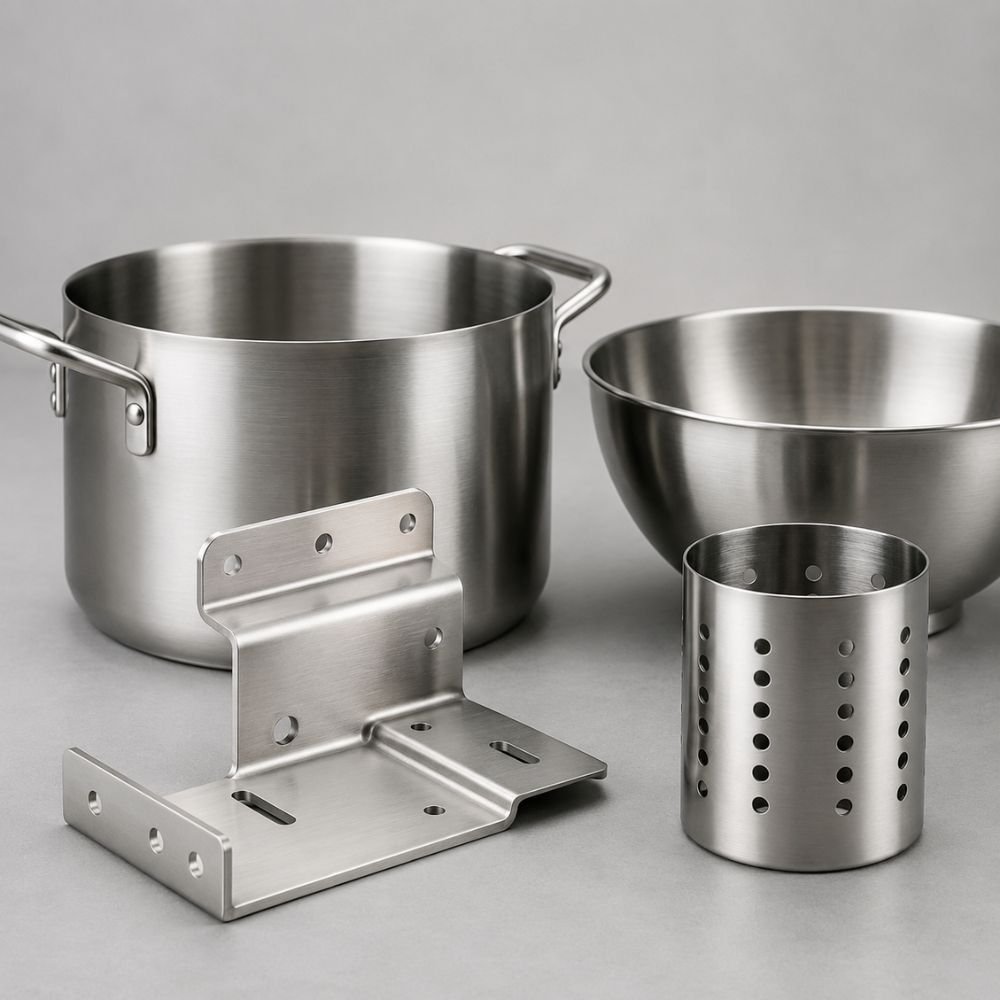
SUS 304 Equivalent Grades
| Standard | Grade Designation |
|---|---|
| JIS | SUS 304 |
| AISI | 304 |
| ASTM / UNS | Type 304 / S30400 |
| EN | 1.4301 |
| EN Name | X5CrNi18-10 |
Equivalent grade names may vary by regional standards and customer specifications. Final material confirmation should be based on the applicable standard, mill certificate, and order requirements.
What Is SUS 304 Stainless Steel?
SUS 304 is an iron-based chromium-nickel stainless steel with an austenitic microstructure. Chromium forms a thin, self-repairing passive layer on the surface, helping protect the steel against oxidation and many common corrosive environments.
Nickel stabilizes the austenitic structure and contributes to the material’s ductility, toughness, formability, and weldability. This combination allows SUS 304 to be fabricated into stainless steel coil, sheet, strip, plate, tubes, containers, panels, and precision components.
Type 304 is recognized internationally as a typical 18% chromium and 8% nickel austenitic grade. worldstainless and the Nickel Institute provide additional background on this composition and structure.
Key Characteristics of SUS 304
Good General Corrosion Resistance
SUS 304 performs well in many indoor, atmospheric, freshwater, food-processing, and mildly corrosive environments. Its passive chromium-oxide layer helps protect the underlying metal when the surface is properly fabricated, cleaned, and maintained.
Excellent Formability
The grade can be bent, stamped, drawn, rolled, and formed into complex shapes. It is frequently selected for sinks, containers, enclosures, appliance panels, covers, architectural components, and precision-stamped parts.
Good Weldability
SUS 304 can be welded using common stainless steel welding processes. Appropriate welding procedures, compatible filler materials, surface cleaning, and post-weld treatment may be required to preserve corrosion resistance.
Strong Low-Temperature Performance
Austenitic stainless steels retain good toughness at low and cryogenic temperatures, making SUS 304 suitable for applications that may experience cold operating conditions.
Suitable for Elevated Temperatures
SUS 304 provides useful oxidation resistance at elevated temperatures. However, allowable temperature depends on loading, exposure duration, atmosphere, fabrication condition, and the applicable engineering standard.
Attractive and Maintainable Surface
SUS 304 is available in multiple surface finishes, including No.1, 2B, BA, No.3, No.4, hairline, and other polished or decorative finishes.
Generally Non-Magnetic in the Annealed Condition
Annealed SUS 304 is generally described as non-magnetic or only weakly magnetic. Cold working, forming, machining, or welding can create some magnetic response. It should therefore not be described as completely non-magnetic in every condition.
SUS 304 Chemical Composition
| Element | Symbol | Typical Specification, wt.% |
|---|---|---|
| Carbon | C | ≤ 0.08 |
| Silicon | Si | ≤ 1.00 |
| Manganese | Mn | ≤ 2.00 |
| Phosphorus | P | ≤ 0.045 |
| Sulfur | S | ≤ 0.030 |
| Chromium | Cr | 18.00–20.00 |
| Nickel | Ni | 8.00–10.50 |
| Iron | Fe | Balance |
Chemical composition values are provided as reference information. Final material composition should be confirmed based on the applicable standard, mill certificate, and customer order requirements.
SUS 304 Mechanical Properties
| Property | Common Reference Value |
|---|---|
| 0.2% Proof Strength | ≥ 205 MPa |
| Tensile Strength | ≥ 520 MPa |
| Elongation | ≥ 40% |
| Rockwell Hardness | ≤ 90 HRB |
| Vickers Hardness | ≤ 200 HV |
Mechanical properties are common reference values. Final performance may vary depending on applicable standard, material condition, thickness, processing method, and customer specifications.
Physical Properties of SUS 304
| Physical Property | Typical Value |
|---|---|
| Density | Approximately 7.93 g/cm³ |
| Elastic Modulus | Approximately 193 GPa |
| Thermal Conductivity at Room Temperature | Approximately 16.2 W/m·K |
| Specific Heat | Approximately 500 J/kg·K |
| Mean Thermal Expansion | Approximately 17.2 µm/m·K |
| Electrical Resistivity | Approximately 0.72 µΩ·m |
| Magnetic Behavior | Generally non-magnetic when annealed; may become magnetic after cold working |
Physical property values are typical references for SUS 304 stainless steel. Final values may vary depending on material condition, processing history, thickness, temperature, and applicable material standard.
SUS 304 vs. SUS 304L
| Feature | SUS 304 | SUS 304L |
|---|---|---|
| Carbon Content | Standard low-carbon range | Lower carbon, commonly ≤ 0.03% |
| General Corrosion Resistance | Good | Similar in many environments |
| Welding Performance | Good | Better resistance to weld-related sensitization |
| High-Temperature Strength | Generally better than 304L | May be more limited in some high-temperature applications |
| Common Selection Reason | General fabrication and broad availability | Welded structures and corrosion-sensitive welded components |
SUS 304 and SUS 304L are closely related stainless steel grades. Final material selection should be based on welding requirements, corrosion environment, operating temperature, fabrication method, and applicable material standards.
SUS 304 vs. SUS 316
| Feature | SUS 304 | SUS 316 |
|---|---|---|
| Main Alloy System | Chromium-nickel | Chromium-nickel-molybdenum |
| General Corrosion Resistance | Very good | Very good |
| Chloride Resistance | Moderate | Better than 304 |
| Coastal or Marine Exposure | Limited without careful evaluation | Usually preferred, but still requires evaluation |
| Material Cost | Generally lower | Generally higher |
| Typical Use | Food equipment, appliances, architecture, general fabrication | Marine, coastal, chemical, pharmaceutical, and chloride-exposed equipment |
SUS 304 and SUS 316 are both austenitic stainless steel grades. SUS 304 is often selected for general fabrication, food equipment, appliances, and architectural applications, while SUS 316 is usually preferred when chloride, coastal, marine, chemical, or more corrosive environments are involved.
Corrosion Resistance of SUS 304
For marine, coastal, saltwater, or chloride-intensive environments, SUS 316 or 316L is often evaluated because its molybdenum content provides better resistance to chloride-related corrosion. Grade selection must still be based on the actual chemical concentration, temperature, exposure time, cleaning procedure, and component design.
SUS 304 provides good corrosion resistance in many general-service environments, but it is not corrosion-proof.
- Indoor and sheltered architectural environments
- Freshwater and normal humid conditions
- Food and beverage processing
- Kitchen and catering equipment
- Mild alkaline and oxidizing environments
- General industrial and fabrication applications
SUS 304 may experience pitting, crevice corrosion, or stress-corrosion cracking when exposed to:
- Seawater
- Coastal salt deposits
- Chloride-rich cleaning chemicals
- Swimming-pool environments
- High temperatures combined with chlorides
- Poorly drained crevices
- Prolonged exposure to aggressive acids
SUS 304 Stainless Steel Applications
Food and Beverage Equipment
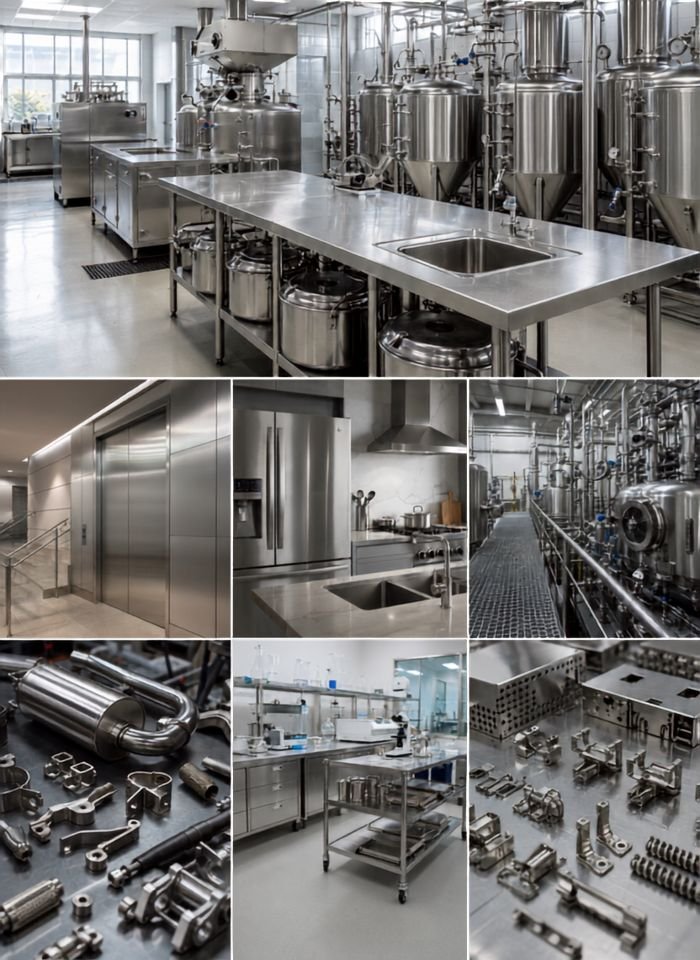
SUS 304 is widely used for food-processing machinery, preparation surfaces, tanks, sinks, storage containers, brewing equipment, dairy equipment, and commercial kitchen components.
Architectural and Construction Components
Common applications include interior panels, handrails, elevator finishes, doors, frames, roofing details, decorative trim, and building hardware.
Industrial and Chemical Equipment
SUS 304 may be used for tanks, enclosures, covers, process equipment, piping components, and general industrial assemblies when the operating environment is compatible with the grade.
Automotive and Transportation
Applications include trim, clamps, brackets, fasteners, exhaust-related components, formed parts, and transportation equipment.
Medical and Laboratory Equipment
Its cleanability, formability, and general corrosion resistance make SUS 304 suitable for selected equipment housings, trays, work surfaces, containers, and laboratory components. Medical suitability must be evaluated according to the exact device, sterilization process, and regulatory requirements.
Electronics and Precision Manufacturing
SUS 304 is used for enclosures, shielding components, terminals, clips, precision-stamped parts, springs in work-hardened conditions, and equipment structures.
faq
Stainless Steel CSP Material FAQ
SUS 304 is the JIS designation for a widely used austenitic stainless steel grade. It is commonly associated with AISI 304, UNS S30400, and EN 1.4301. Exact requirements should be checked against the specified standard.
It is called 18-8 stainless steel because the alloy contains approximately 18% chromium and 8% nickel. The exact permitted composition varies within the limits of the applicable standard.
SUS 304 has good corrosion resistance, but it can corrode under unsuitable conditions. Chlorides, salt deposits, contamination by carbon steel, poor drainage, crevices, aggressive chemicals, and inadequate cleaning can lead to staining or localized corrosion.
Annealed SUS 304 is generally non-magnetic or weakly magnetic. It may become partially magnetic after cold rolling, bending, stamping, machining, or welding.
SUS 304 is extensively used in food and beverage equipment because it offers good corrosion resistance, cleanability, and fabrication performance. Suitability still depends on the food chemistry, cleaning chemicals, temperature, surface finish, and applicable regulations.
Take Action