
STAINLESS STEEL GRADE
SUS 316L Stainless Steel
SUS 316L is a low-carbon austenitic stainless steel designed for welded components and applications requiring greater resistance to chlorides and localized corrosion than SUS 304 or SUS 304L.
Its composition typically includes 16–18% chromium, 10–14% nickel, and 2–3% molybdenum. The addition of molybdenum improves resistance to pitting and crevice corrosion, while the low carbon content helps reduce sensitization and intergranular corrosion around welded areas.SUS 316L is widely used for chemical-processing equipment, pharmaceutical systems, food-processing machinery, coastal structures, marine-related components, tanks, piping, and other fabricated products exposed to demanding environments.
SUS 316L is commonly associated with AISI 316L, ASTM Type 316L, UNS S31603, and EN 1.4404. Final requirements should be verified against the applicable material standard and Mill Test Certificate.
MATERIAL INTRODUCTION
SUS 316L Stainless Steel Overview
SUS 316L is the low-carbon version of SUS 316 stainless steel. The “L” designation indicates a carbon content generally limited to 0.03%, reducing chromium-carbide precipitation during welding.
The grade contains molybdenum, which gives it better resistance to chlorides and reducing acids than SUS 304-series stainless steel. This makes SUS 316L a common choice for welded tanks, piping, process equipment, food-contact systems, pharmaceutical equipment, and components used near coastal environments.
However, SUS 316L is not completely resistant to seawater, salt, acids, or all chemicals. Grade selection must consider chemical concentration, chloride level, temperature, pressure, exposure time, surface condition, fabrication method, and cleaning procedures.
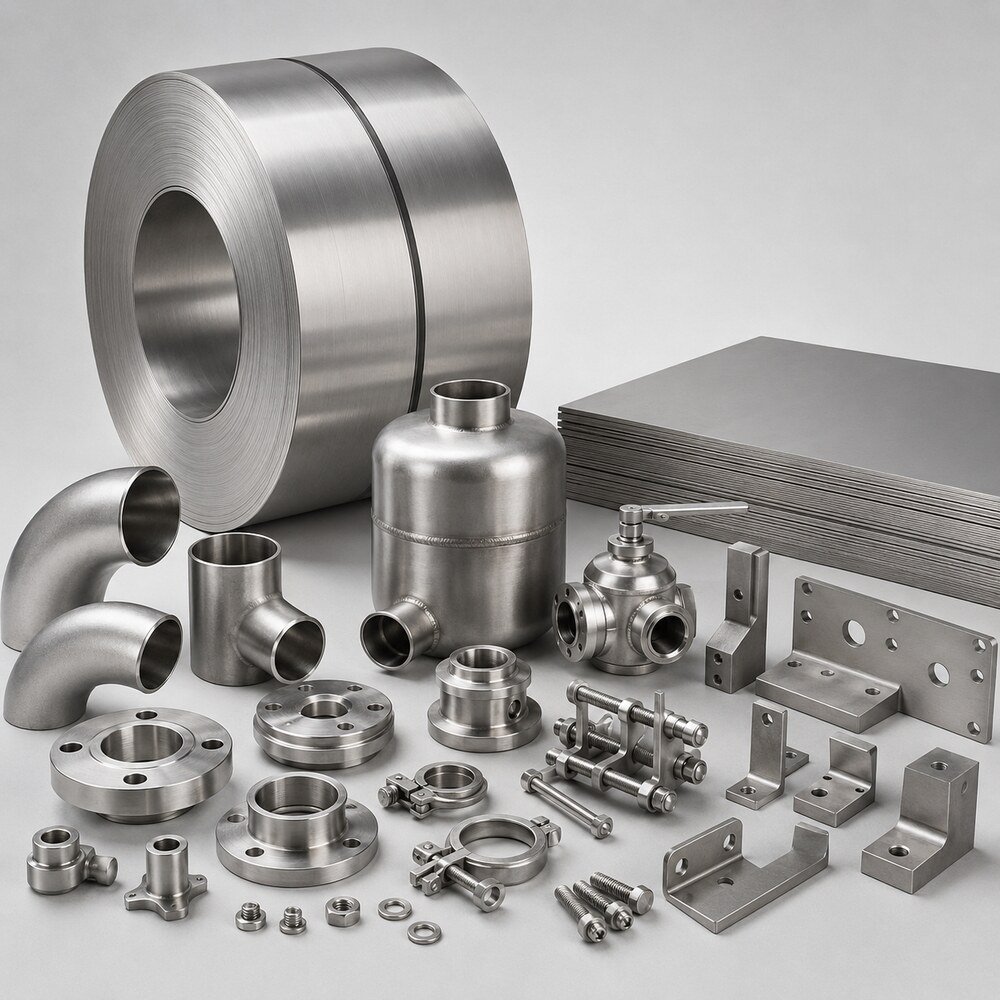
SUS 316L Equivalent Grades
| Standard | Grade Designation |
|---|---|
| JIS | SUS 316L |
| AISI | 316L |
| ASTM / UNS | Type 316L / S31603 |
| EN | 1.4404 |
| EN Name | X2CrNiMo17-12-2 |
Equivalent designations are broadly comparable but may differ in chemical limits, mechanical requirements, testing, dimensional tolerances, and certification. Confirm the governing material standard before ordering.
Key Characteristics of SUS 316L
Improved Chloride Resistance
SUS 316L provides better resistance to localized corrosion caused by chlorides than SUS 304L. It is therefore frequently evaluated for coastal, food-processing, chemical, pharmaceutical, and water-related applications.
Low Carbon for Welding
Its low carbon content reduces the risk of sensitization during welding and helps preserve corrosion resistance in heat-affected areas.
Excellent Weldability
SUS 316L can be welded using common stainless steel welding processes. It is widely used for fabricated tanks, piping, pressure-related components, process equipment, frames, and enclosures.
Good Formability
The grade can be bent, rolled, stamped, drawn, and formed into complex components. Cold working can increase strength and hardness while reducing ductility.
Hygienic and Maintainable Surface
SUS 316L can be supplied with No.1, 2B, BA, No.3, No.4, hairline, polished, and application-specific surface finishes.
Good Low-Temperature Toughness
Its austenitic structure retains good toughness and ductility at low and cryogenic temperatures.
Generally Non-Magnetic When Annealed
Annealed SUS 316L is generally non-magnetic or weakly magnetic. Cold working, forming, machining, and welding may create some magnetic response.
SUS 316L Chemical Composition
| Element | Symbol | Minimum (wt.%) | Maximum (wt.%) |
|---|---|---|---|
| Carbon | C | — | 0.030 |
| Silicon | Si | — | 1.00 |
| Manganese | Mn | — | 2.00 |
| Phosphorus | P | — | 0.045 |
| Sulfur | S | — | 0.030 |
| Chromium | Cr | 16.00 | 18.00 |
| Nickel | Ni | 10.00 | 14.00 |
| Molybdenum | Mo | 2.00 | 3.00 |
| Nitrogen | N | — | 0.10 |
| Iron | Fe | Balance | |
ASTM identifies Type 316L as UNS S31603. Composition limits can vary with the applicable product standard, so final values should be verified using the governing specification and Mill Test Certificate.
SUS 316L Mechanical Properties
| Mechanical Property | Common Reference Value |
|---|---|
| 0.2% Proof Strength | ≥175 MPa |
| Tensile Strength | ≥485 MPa |
| Elongation | ≥40% |
| Rockwell Hardness | ≤90 HRB |
| Vickers Hardness | ≤200 HV |
Mechanical values vary according to product form, thickness, material condition, test direction, heat treatment, and governing specification. Cold-rolled or work-hardened SUS 316L can provide higher strength than annealed material, usually with reduced elongation.
Physical Properties of SUS 316L
| Physical Property | Typical Value |
|---|---|
| Density | Approximately 8.0 g/cm³ |
| Elastic Modulus | Approximately 193 GPa |
| Thermal Conductivity at Room Temperature | Approximately 16.3 W/m·K |
| Specific Heat | Approximately 500 J/kg·K |
| Mean Thermal Expansion | Approximately 16.0 µm/m·K |
| Electrical Resistivity | Approximately 0.74 µΩ·m |
| Magnetic Behavior | Generally non-magnetic when annealed; cold working, forming, machining, or welding may produce some magnetic response |
These values are typical references and may vary according to temperature, product form, processing condition, and test method. SUS 316L has lower thermal conductivity than carbon steel, aluminum, and copper.
SUS 316L vs. SUS 304L
| Feature | SUS 304L | SUS 316L |
|---|---|---|
| Main Alloy System | Chromium-nickel | Chromium-nickel-molybdenum |
| Molybdenum Content | Not intentionally added | Approximately 2–3% |
| Carbon Content | Commonly ≤0.03% | Commonly ≤0.03% |
| General Corrosion Resistance | Good in many general environments | Better in more demanding environments |
| Chloride Resistance | Moderate | Better resistance to chloride-induced corrosion |
| Pitting and Crevice Corrosion | More vulnerable in chloride-rich conditions | Better resistance due to molybdenum |
| Weldability | Excellent | Excellent |
| Coastal Exposure | Requires careful evaluation | Generally preferred over SUS 304L |
| Typical Material Cost | Generally lower | Generally higher |
| Typical Applications | Indoor architecture, food equipment, appliances, welded tanks, and general industrial fabrication | Chemical processing, pharmaceutical equipment, coastal components, water systems, and chloride-exposed applications |
| Common Selection Reason | Cost-effective low-carbon grade for general welded fabrication | Improved resistance to chlorides and localized corrosion |
Choose SUS 304L for general welded fabrication in compatible indoor, architectural, food-processing, and industrial environments without significant chloride exposure.
Choose SUS 316L when the application requires better resistance to chlorides, localized corrosion, coastal exposure, certain chemicals, or more demanding cleaning conditions.
Neither grade is universally better. Final selection should consider chloride concentration, chemical exposure, operating temperature, fabrication method, surface finish, cleaning procedure, expected service life, and applicable engineering standards.
Corrosion Resistance of SUS 316L
SUS 316L offers better chloride resistance than SUS 304L, particularly against pitting and crevice corrosion. Its pitting resistance equivalent is also higher because of its molybdenum content. Nickel Institute
Commonly Suitable Environments
SUS 316L is frequently considered for:
- Coastal and salt-contaminated atmospheric environments
- Food and beverage processing
- Pharmaceutical manufacturing
- Chemical-processing equipment
- Freshwater and treated-water systems
- Pulp and paper equipment
- Laboratories and clean-process environments
- Welded tanks and piping
- Architectural components exposed to demanding conditions
Important Corrosion Limitations
SUS 316L is not automatically suitable for:
- Continuous seawater immersion
- Stagnant saltwater
- High chloride concentrations
- Hot chloride solutions
- Hydrochloric acid
- Strong reducing acids
- Poorly drained crevices
- High-temperature chloride exposure
- Environments capable of causing chloride stress-corrosion cracking
Maintaining SUS 316L Corrosion Resistance
- Avoid contamination from carbon-steel tools and grinding dust
- Remove weld discoloration and fabrication residues
- Use suitable pickling or passivation when required
- Prevent stagnant liquid and poorly drained crevices
- Select the appropriate surface finish for the environment
- Control cleaning chemicals and chloride concentrations
- Establish an appropriate inspection and maintenance schedule
SUS 316L Stainless Steel Applications
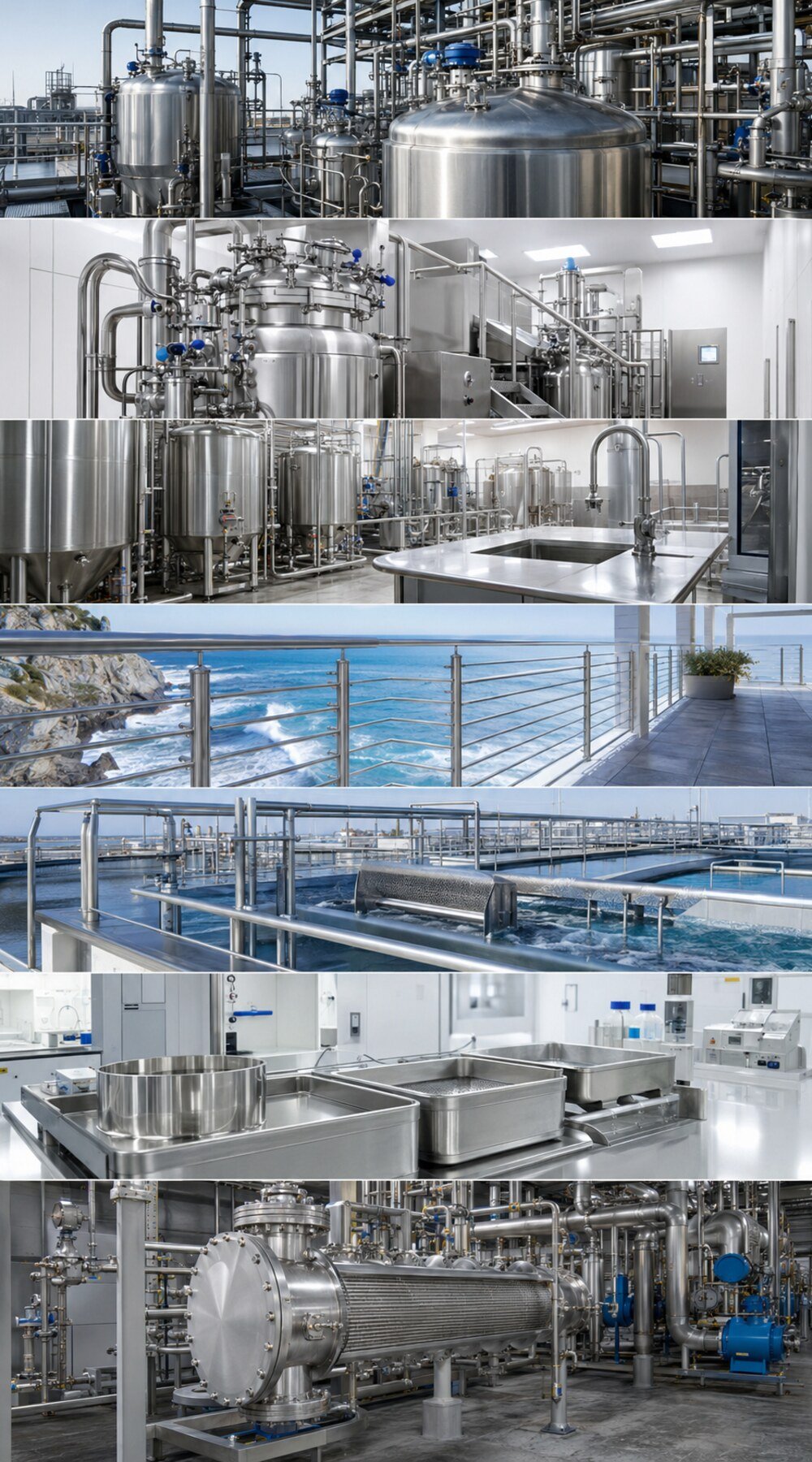
Chemical and Process Equipment
SUS 316L is used for tanks, vessels, piping, valves, covers, enclosures, and process components handling compatible chemicals.
Pharmaceutical Equipment
Its corrosion resistance, weldability, cleanability, and surface-finish options make it a common material for product-contact equipment, processing systems, tanks, piping, and clean environments. Type 316 is commonly used for pharmaceutical product-contact applications, but selection must also consider the cleaning agents and service environment. Nickel Institute
Food and Beverage Processing
Applications include food-processing machinery, brewing and dairy systems, mixing vessels, storage tanks, piping, work surfaces, and components exposed to salt-containing food or aggressive cleaning procedures.
Coastal and Marine-Related Components
SUS 316L is commonly used for coastal architectural components, marine hardware, fasteners, railings, enclosures, and equipment exposed to salt spray.
It should not be described as universally “marine-grade” without evaluating immersion, temperature, chloride concentration, and maintenance conditions.
Water-Treatment Equipment
Applications include tanks, piping, brackets, screens, covers, and processing components used in compatible freshwater and treated-water conditions.
Medical and Laboratory Equipment
SUS 316L is used for selected surgical instruments, equipment housings, trays, laboratory systems, and medical components.
Do not claim that ordinary commercial SUS 316L is automatically suitable for implants or artificial joints. Implant applications require specialized material specifications, manufacturing controls, surface conditions, testing, and regulatory approval.
Energy and Industrial Equipment
The grade is used in heat exchangers, energy-processing equipment, fabricated assemblies, instrumentation, enclosures, and corrosion-resistant industrial components.
faq
Stainless Steel CSP Material FAQ
The “L” indicates low carbon. SUS 316L generally contains no more than approximately 0.03% carbon, reducing sensitization during welding.
SUS 316L contains molybdenum, giving it better resistance to chlorides, pitting, crevice corrosion, and certain reducing acids.
No stainless steel is completely rust-proof. SUS 316L can corrode when exposed to excessive chlorides, high temperatures, aggressive chemicals, contamination, stagnant liquid, or poorly designed crevices.
It may be suitable for selected intermittent or atmospheric marine applications, but continuous or stagnant seawater exposure can cause localized corrosion. Duplex or higher-alloy grades may be required.
SUS 304L is generally not the preferred grade for seawater or aggressive chloride exposure. SUS 316L, duplex stainless steel, or a higher-alloy grade may be more appropriate.
Take Action