
STAINLESS STEEL FOR ARCHITECTURE AND DECORATIVE FABRICATION
Stainless Steel for Architecture & Decorative Applications
Genn-Hann supplies stainless steel coil, sheet and precision strip for architectural panels, interior finishes, decorative components, elevator systems, signage and fabricated building products. Available grades, dimensions and surface finishes can be processed to support appearance, durability, formability and project-specific fabrication requirements.
Industry Introduction
Why Stainless Steel Is Used in Architectural and Decorative Applications
Stainless steel combines corrosion resistance with a clean, modern appearance and long service life. Its ability to be formed, welded, polished and incorporated into fabricated systems makes it suitable for functional and decorative components used in commercial buildings, public spaces, transportation facilities, retail environments and residential projects.
Material performance depends on the selected grade, surface finish, installation environment, fabrication method and maintenance plan. Exterior, coastal and high-traffic applications require particular attention to corrosion exposure, surface direction, fastening details and cleaning accessibility.
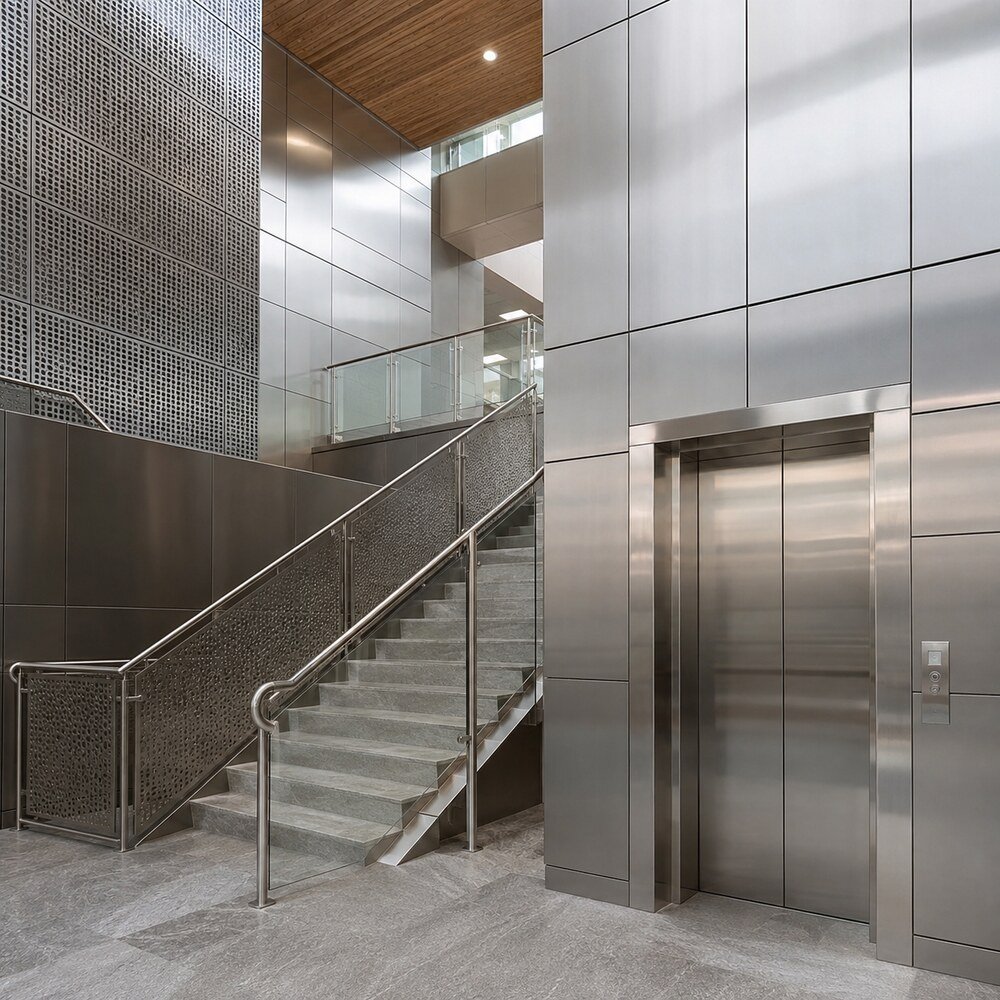
FROM BUILDING ENVELOPES TO INTERIOR DETAILS
Stainless Steel Applications for Architecture and Decorative Fabrication
SELECT GRADES BASED ON EXPOSURE, APPEARANCE AND FABRICATION
Stainless Steel Grades for Architectural and Decorative Applications
Architectural stainless steel selection should balance corrosion resistance, forming and welding requirements, surface-finish compatibility, installation conditions and project budget. Interior decorative components may use general-purpose austenitic or ferritic grades, while exterior, coastal and chemically exposed environments may require higher corrosion resistance.
| Stainless Steel Grade | Recommended Positioning | Grade Details |
|---|---|---|
| SUS 304 / 304L | A versatile choice for interior panels, elevator components, entrance systems, signage, trims and selected exterior architectural components requiring good formability, weldability and corrosion resistance. | |
| SUS 316 / 316L | Considered for coastal, humid, chloride-exposed or more demanding architectural environments. Final suitability depends on the location, detailing, surface finish and maintenance plan. | |
| SUS 430 | A cost-conscious ferritic option for selected indoor decorative panels, appliance-style finishes, trims and fabricated components where the specified corrosion resistance and forming requirements permit. | View grade → |
| SUS 201 / 202 | May be evaluated for selected interior decorative components, furniture, trim and fabricated products where the environment, forming requirements and project specification permit their use. | View grade → |
Available Stainless Steel Material Forms
Stainless Steel Strip
Cold rolled stainless steel precision strips for stamping, electronics components, springs, clips, brackets, clamps, fasteners, and small metal parts.
Stainless Steel Coil
Cold rolled and hot rolled stainless steel coils for slitting, cutting, polishing, and customized downstream processing. Suitable for manufacturers that need stable material supply, flexible dimensions, and consistent surface quality.
Stainless Steel Sheet
Cold rolled stainless steel sheets and hot rolled stainless steel plates for panels, covers, machinery parts, appliance components, fabrication, and visible stainless steel products.
Cold Rolled Stainless Steel Hardness CSP material
Cold rolled stainless steel hardness CSP material for applications that require strength, elasticity, hardness stability, and precision performance, such as springs, clips, terminals, brackets, electronics components, and precision stamped parts.
Stainless steel Coating
Cold rolled stainless steel painted steel coil for products that require color, surface design, durability, and a customized visual appearance, such as decorative panels, appliances, architectural elements, visible parts, and design-focused stainless steel applications.
CUSTOMIZED DIMENSIONS AND FINISHES FOR CONSISTENT FABRICATION
Precision Stainless Steel Processing for Architectural Projects
Material Prepared for Downstream Fabrication
Surface Options for Functional and Decorative Requirements
Why Architectural Fabricators Choose Genn-Hann
Architectural projects require more than a visually attractive finish. Genn-Hann combines material selection support, customized processing, surface-finishing options and controlled production to help fabricators source stainless steel suited to project-specific dimensions, appearance and manufacturing requirements.
Material Selection Support
Guidance on stainless steel grades, material forms, dimensions and finishes based on the installation environment, component design and fabrication requirements.
Customized Processing
Precision slitting, cut-to-length sheet processing and polishing for customized thickness, width, length and surface specifications.
Decorative Surface Options
Selected 2B, BA, No.3, No.4, hairline and SB finishes support different architectural appearances and downstream fabrication requirements.
Quality-Controlled Production
Inspection equipment, production monitoring and documented process control help maintain dimensional and surface consistency.
Automated Warehousing and ERP Control
Integrated inventory and order management support material tracking, processing coordination and repeat-order control.
Flexible Material Supply
Access to 200, 300 and 400-series stainless steel in coil, sheet, precision strip and CSP material forms.
Global Delivery Support
Export experience and flexible land, sea and air logistics support architectural fabricators and manufacturers across international supply chains.
Information to Provide When Requesting Stainless Steel
Complete Specifications Help Us Recommend the Right Material and Processing Solution
Providing complete technical and commercial requirements allows Genn-Hann to review material suitability, confirm processing capabilities and prepare a more accurate quotation. Include the intended application, stainless steel grade, dimensions, tolerances, surface requirements, order quantity and delivery destination whenever possible.
Intended Application
Describe the component, equipment or operating environment in which the stainless steel will be used.
Stainless Steel Grade
Specify the required grade, such as SUS 304, 304L, 316L, 301, 430 or another customer-approved material.
Applicable Material Standard
Include the required ASTM, JIS, EN or customer-specific material standard when applicable.
Product Form
Indicate whether the material is required as stainless steel coil, sheet, precision strip or CSP material.
Dimensions and Tolerances
Provide the required thickness, width, length and acceptable dimensional tolerances.
Temper or Hardness
State the required temper, hardness range or mechanical-property requirements for formed or spring components.
Surface Finish
Specify the required surface condition or finish, such as 2B, BA, No.3, No.4, Hairline or SB.
Edge and Flatness Requirements
Include any requirements for slit-edge condition, burr control, flatness, sheet shape or coil configuration.
Surface Protection and Packaging
Identify protective-film, paper-interleaving, moisture protection, labeling or export-packaging requirements.
Fabrication Method
Explain whether the material will be stamped, formed, welded, polished, laser cut or processed using another manufacturing method.
Order Quantity
Provide the estimated quantity, preferred coil weight, sheet count or expected recurring demand.
Delivery Requirements
Include the destination country, requested delivery date and any preferred shipping or documentation requirements.
Need help preparing your specification? Send the available drawings, material requirements or application details to Genn-Hann for review. Contact our material specialists.
faq
Frequently Asked Questions About Stainless Steel for Architecture & Decorative Components
01 Which stainless steel grade is suitable for exterior architecture?
SUS 304 or 304L may be suitable for many urban and low-chloride exterior environments. SUS 316 or 316L is generally considered for coastal locations, swimming-pool areas, deicing-salt exposure and other chloride-containing environments.
Final selection must consider site exposure, surface finish, component geometry, fabrication details and planned cleaning frequency.
02 When should SUS 316L be selected instead of SUS 304?
SUS 316L contains molybdenum, which improves resistance to localized pitting and crevice corrosion in many chloride-containing environments.
It may be preferred for coastal façades, exterior components exposed to road salt, humid industrial locations and selected pool environments. Grade selection still requires a project-specific exposure assessment.
03 Can SUS 430 be used for architectural applications?
Yes, for selected applications. SUS 430 is a ferritic stainless steel that can provide an attractive surface and economical material option for indoor wall panels, elevator components, trims, displays and decorative fixtures.
Its corrosion resistance is generally lower than that of SUS 304 or 316L, so it should not be substituted without reviewing the installation environment and project specification.
04 What stainless steel finish is commonly used for architecture?
No.4 and hairline finishes are commonly selected for elevator interiors, entrance systems, wall panels, trims and decorative metalwork. BA and 2B may be used where a brighter or mill-finished appearance meets the design requirements.
The appropriate finish depends on appearance, location, handling, fabrication, cleaning and maintenance requirements.
05 Does a polished finish improve stainless steel corrosion resistance?
A smoother, correctly produced surface can reduce sites where contaminants and moisture accumulate, supporting cleanability and corrosion performance.
However, polishing cannot make an unsuitable grade appropriate for a severe environment. Grade, finish quality, fabrication, installation detailing and maintenance must be considered together.
06 Why should the polishing direction be specified?
Directional finishes such as No.4 and hairline reflect light differently depending on grain orientation. Mixing polishing directions across adjacent panels can create an obvious visual mismatch.
Drawings and purchase specifications should define the grain direction, especially for façades, elevator doors, wall panels and adjoining decorative components.
07 Why should finish samples be approved before production?
Finish names alone may not fully define the visual result. Appearance can vary with abrasive type, grit sequence, polishing pressure, grain direction, material batch, forming and lighting.
An approved representative sample establishes a practical reference for color, reflectivity, texture and directional appearance before full production begins.
08 Can adjacent stainless steel panels show color or finish differences?
Yes. Differences in coil batch, polishing equipment, grain direction, protective film, fabrication and lighting can make neighboring panels appear different.
For visually continuous areas, material should be coordinated by batch where practical, processed to an approved finish reference and installed with a consistent grain orientation.
09 What causes tea staining on exterior stainless steel?
Tea staining is a brown surface discoloration associated with deposited salts, moisture, pollution and insufficient cleaning. It is more likely in coastal, sheltered or chloride-exposed locations where rain cannot regularly wash the surface.
Appropriate grade selection, smoother finishes, drainage, exposure to natural washing and scheduled cleaning can reduce the risk.
10 Does stainless steel require maintenance after installation?
Yes. Stainless steel is corrosion resistant, not maintenance-free. Exterior and high-touch surfaces should be cleaned at intervals appropriate to the local environment and contamination level.
Coastal deposits, road salt, industrial pollution, fingerprints and cleaning residues should not be allowed to remain on the surface indefinitely.
11 How should architectural stainless steel be cleaned?
Routine cleaning normally uses clean water with a mild detergent, followed by rinsing and drying. Directionally polished surfaces should be cleaned along the grain.
Abrasive carbon-steel tools, steel wool and chloride-containing cleaners should be avoided because they can scratch the finish, deposit free iron or increase corrosion risk. Cleaning products should first be tested on an inconspicuous area.
12 Can carbon steel contaminate architectural stainless steel?
Yes. Contact with carbon-steel grinding dust, wire brushes, tools, storage racks or fabrication equipment can transfer free iron to the stainless steel surface.
The transferred iron can rust and create the appearance that the stainless steel itself is corroding. Separate tools, clean handling areas and suitable post-fabrication cleaning help prevent contamination.
13 Why is protective film used on decorative stainless steel sheet?
Protective film helps reduce scratching, fingerprints and handling damage during cutting, forming, transportation and installation.
The film must be compatible with the processing method and should be removed within the supplier’s recommended period. Prolonged weather or heat exposure can make the film or adhesive difficult to remove.
14 What information should be specified when ordering decorative stainless steel?
Provide the grade, material form, thickness, width, length, surface finish, grain direction, flatness or dimensional tolerances, edge condition, protective-film requirement, quantity and delivery schedule.
The installation environment, downstream fabrication process, approved finish sample, packaging method and required certificates should also be identified.
Take Action