
STAINLESS STEEL GRADE
SUS 409L Stainless Steel
SUS 409L is a low-carbon, titanium-stabilized ferritic stainless steel developed for applications requiring economical corrosion protection, weldability, and resistance to elevated-temperature oxidation.
Containing approximately 10.5–11.75% chromium, SUS 409L provides better corrosion and oxidation resistance than ordinary carbon steel while remaining more economical than higher-chromium or nickel-containing stainless steel grades.It is used primarily for automotive exhaust pipes, mufflers, catalytic-converter components, heat shields, agricultural equipment, furnace parts, and other components exposed to exhaust gases and repeated heating and cooling.
SUS 409L is magnetic and is commonly associated with UNS S40903 and EN 1.4512.
MATERIAL INTRODUCTION
SUS 409L Stainless Steel Overview
SUS 409L is part of the ferritic stainless steel family. Its microstructure gives it magnetic properties, relatively low thermal expansion, useful heat conductivity, and lower material cost than austenitic grades such as SUS 304.
Titanium stabilizes carbon and nitrogen within the steel. This helps reduce sensitization, improve weld-area performance, and maintain the material’s properties during fabrication and thermal cycling.
SUS 409L was developed primarily for automotive exhaust applications rather than decorative or severely corrosive environments. World Stainless identifies Type 409 as a grade originally designed for automotive exhaust silencers and other applications where minor localized corrosion may be acceptable. World Stainless
SUS 409L Equivalent Grades
| Standard | Grade Designation |
|---|---|
| JIS | SUS 409L |
| AISI | 409L |
| ASTM / UNS | Type 409L / S40903 |
| EN | 1.4512 |
| EN Name | X2CrTi12 |
Equivalent designations are broadly comparable but may differ in chemical composition, stabilization requirements, mechanical properties, available product forms, testing, and certification. Confirm the governing material standard before ordering.
Key Characteristics of SUS 409L
Designed for Automotive Exhaust Systems
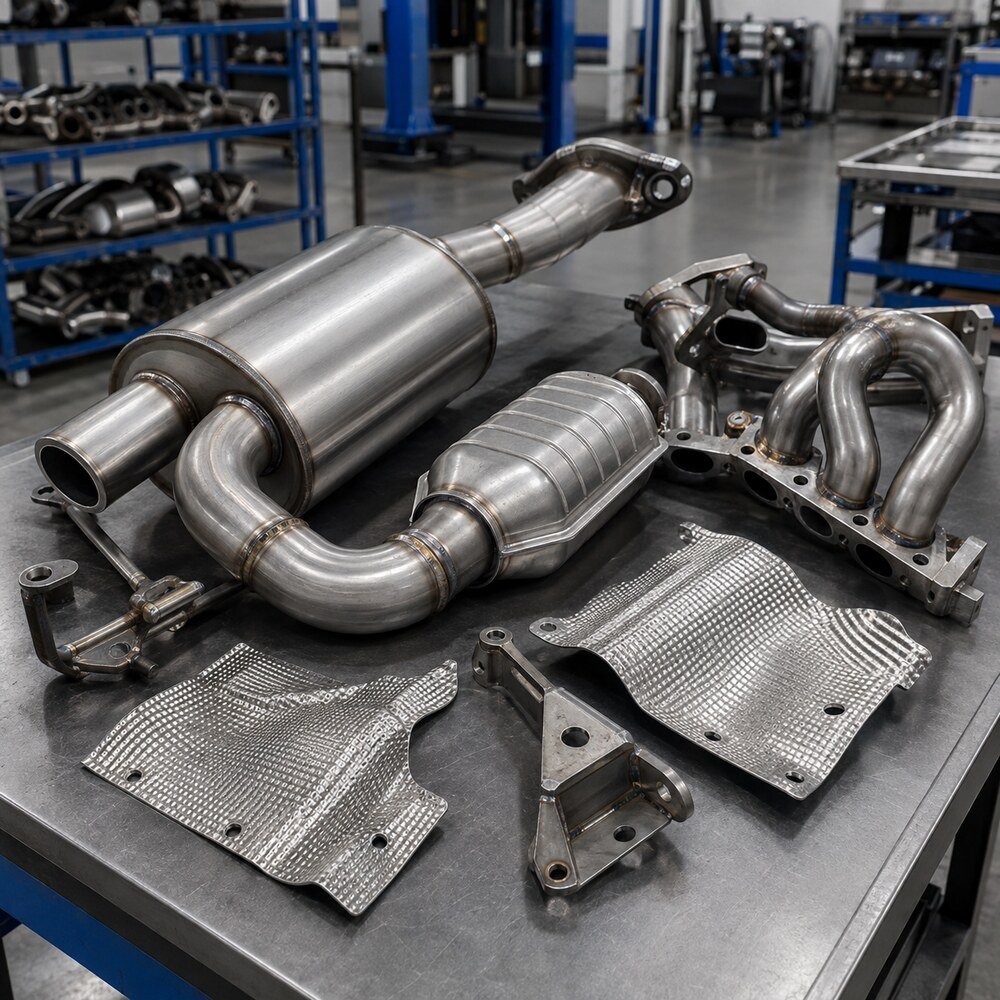
SUS 409L is widely used for exhaust pipes, mufflers, catalytic-converter shells, heat shields, and related components exposed to hot exhaust gases.
Titanium-Stabilized Composition
Titanium combines with carbon and nitrogen, helping reduce sensitization and improve material performance around welded and heat-affected areas.
Good Oxidation Resistance
SUS 409L provides useful resistance to oxidation in dry air and exhaust-gas environments at elevated temperatures. Actual capability depends on temperature, exposure time, atmosphere, loading, and thermal cycling.
Good Thermal-Fatigue Performance
Its relatively low thermal expansion helps reduce distortion and thermal stress during repeated heating and cooling cycles.
Suitable Weldability
Its low-carbon, titanium-stabilized composition supports welding for exhaust-system assemblies. Heat input, shielding, contamination control, and joint design still require appropriate process control.
Good Formability
SUS 409L can be bent, stamped, roll-formed, and fabricated into exhaust pipes, shells, brackets, shields, and other formed components.
Cost-Effective Ferritic Grade
Its relatively low chromium content and minimal nickel content generally make SUS 409L more economical than SUS 430, SUS 304, and SUS 316L.
Naturally Magnetic
SUS 409L has a ferritic microstructure and is naturally magnetic.
Moderate Corrosion Resistance
SUS 409L provides better corrosion protection than ordinary carbon steel but less than SUS 430 or SUS 304. Surface staining or localized rust may occur in wet, salty, or aggressive environments without necessarily preventing functional service.
SUS 409L Chemical Composition
| Element | Symbol | Minimum (wt.%) | Maximum (wt.%) |
|---|---|---|---|
| Carbon | C | — | 0.030 |
| Silicon | Si | — | 1.00 |
| Manganese | Mn | — | 1.00 |
| Phosphorus | P | — | 0.040 |
| Sulfur | S | — | 0.020 |
| Chromium | Cr | 10.50 | 11.75 |
| Nickel | Ni | — | 0.50 |
| Nitrogen | N | — | 0.030 |
| Titanium | Ti | 6 × (C + N) | 0.50 |
| Iron | Fe | Balance | |
Titanium is used to stabilize carbon and nitrogen. Chemical limits, including sulfur and titanium requirements, may vary among JIS, ASTM, EN, and individual mill specifications. Final composition should be confirmed using the governing material standard and Mill Test Certificate.
SUS 409L Mechanical Properties
Annealed SUS 409L stainless steel provides moderate strength, useful ductility, and good formability for automotive exhaust systems, heat shields, mufflers, fabricated tubing, and other thermally cycled components.
| Mechanical Property | Requirement | Unit |
|---|---|---|
| 0.2% Proof Strength | ≥170 | MPa (N/mm²) |
| Tensile Strength | ≥380 | MPa (N/mm²) |
| Elongation | ≥20 | % |
| Rockwell Hardness | ≤88 | HRB |
| Vickers Hardness | ≤200 | HV |
Reference values generally apply to annealed flat products. Mechanical properties vary according to product form, thickness, heat treatment, processing condition, test direction, and governing specification. Confirm final requirements using the applicable standard and material test certificate.
Physical Properties of SUS 409L
SUS 409L is a ferritic stainless steel with relatively high thermal conductivity and low thermal expansion compared with austenitic grades. These properties support its use in automotive exhaust systems, heat shields, mufflers, furnace components, and other thermally cycled parts.
| Physical Property | Reference Value | Unit |
|---|---|---|
| Density | Approx. 7.6 | g/cm³ |
| Elastic Modulus | Approx. 200–208 | GPa |
| Thermal Conductivity | Approx. 25–26 | W/m·K |
| Specific Heat Capacity | Approx. 460 | J/kg·K |
| Mean Thermal Expansion | Approx. 11 | µm/m·K |
| Electrical Resistivity | Approx. 0.60 | µΩ·m |
| Magnetic Response | Magnetic | — |
Values are approximate room-temperature references and may vary with product form, composition, processing condition, temperature, and testing method. Use the applicable material standard and supplier documentation when physical-property values are required for engineering calculations.
SUS 409L vs. SUS 430
SUS 409L and SUS 430 are ferritic stainless steels, but they are designed for different service conditions. SUS 409L is commonly selected for welded, thermally cycled exhaust components, while SUS 430 is generally preferred when better general corrosion resistance and decorative appearance are required.
| Feature | SUS 409L | SUS 430 |
|---|---|---|
| Stainless Steel Family | Ferritic stainless steel | Ferritic stainless steel |
| Chromium Content | Approximately 10.5–11.75% | Approximately 16–18% |
| Stabilizing Element | Titanium stabilized to support welding and high-temperature service | Generally supplied without titanium stabilization |
| General Corrosion Resistance | Moderate; better than carbon steel but surface staining may occur | Generally better than SUS 409L in mild atmospheric and indoor environments |
| Oxidation and Thermal-Cycling Performance | Designed for exhaust environments and repeated heating and cooling | Useful oxidation resistance, but not as specifically optimized for automotive exhaust fabrication |
| Weldability | Good when suitable ferritic stainless steel procedures are used | Weldable, but heat input and grain growth require careful control |
| Surface Appearance | Usually selected for functional rather than decorative service | Better suited to visible, polished, and decorative components |
| Magnetic Response | Magnetic | Magnetic |
| Typical Applications | Exhaust pipes, mufflers, catalytic-converter shells, heat shields, and industrial exhaust components | Appliance panels, kitchen equipment, interior trim, architectural components, and decorative parts |
| Common Selection Reason | Cost-effective exhaust performance with good thermal-fatigue resistance | Better appearance and corrosion resistance for mildly corrosive environments |
Material selection should consider operating temperature, condensation, chloride exposure, welding requirements, expected appearance, component life, and the applicable engineering specification. Final equivalence and suitability should be confirmed using the governing standard and material test certificate.
Corrosion and Oxidation Resistance of SUS 409L
SUS 409L provides better corrosion and oxidation resistance than ordinary carbon steel, but it is not intended to match the general corrosion resistance of higher-chromium grades such as SUS 430, SUS 304, or SUS 316L. Its principal advantage is its cost-effective performance in automotive exhaust systems and other applications exposed to heat, combustion gases, condensation, and repeated thermal cycling.
General Corrosion Resistance
The chromium content of SUS 409L forms a passive surface layer that provides moderate protection in mildly corrosive environments. Surface discoloration or light staining may occur during outdoor service without necessarily affecting the component’s structural function.
- Better atmospheric corrosion resistance than carbon steel
- Suitable for many dry indoor and mildly corrosive environments
- Useful where functional durability is more important than appearance
- Not recommended for highly corrosive or chloride-rich service
Oxidation and Thermal-Cycling Resistance
SUS 409L is designed to withstand oxidation and repeated heating and cooling in compatible exhaust applications. Its ferritic structure, relatively low thermal expansion, and titanium stabilization support performance under thermal cycling.
- Suitable for automotive exhaust gases and elevated temperatures
- Good resistance to repeated heating and cooling cycles
- Lower thermal expansion than austenitic stainless steel grades
- Commonly used for mufflers, exhaust pipes, and heat shields
Important Service Limitations
SUS 409L should not be selected solely because it is classified as stainless steel. Its suitability depends on temperature, condensation, chloride concentration, atmosphere, drainage, fabrication, and required service life.
- Marine and coastal environments
- Continuous water or saltwater immersion
- Acidic or strongly alkaline chemical processing
- Food-contact applications requiring a maintainable appearance
- Decorative applications where surface staining is unacceptable
Maintaining Material Performance
Proper fabrication and maintenance help preserve the corrosion and oxidation performance of finished SUS 409L components.
- Avoid contamination from carbon-steel tools and grinding particles
- Use suitable welding procedures and control excessive heat input
- Remove fabrication residues and weld contamination where required
- Design components to reduce trapped moisture and stagnant condensate
- Select a compatible surface condition for the service environment
Selection note: Oxidation resistance does not automatically mean resistance to every corrosive environment. Confirm the actual temperature, gas composition, condensate chemistry, chloride exposure, loading, and required appearance before specifying SUS 409L. The applicable engineering standard and material test certificate should govern the final selection.
SUS 430 Stainless Steel Applications
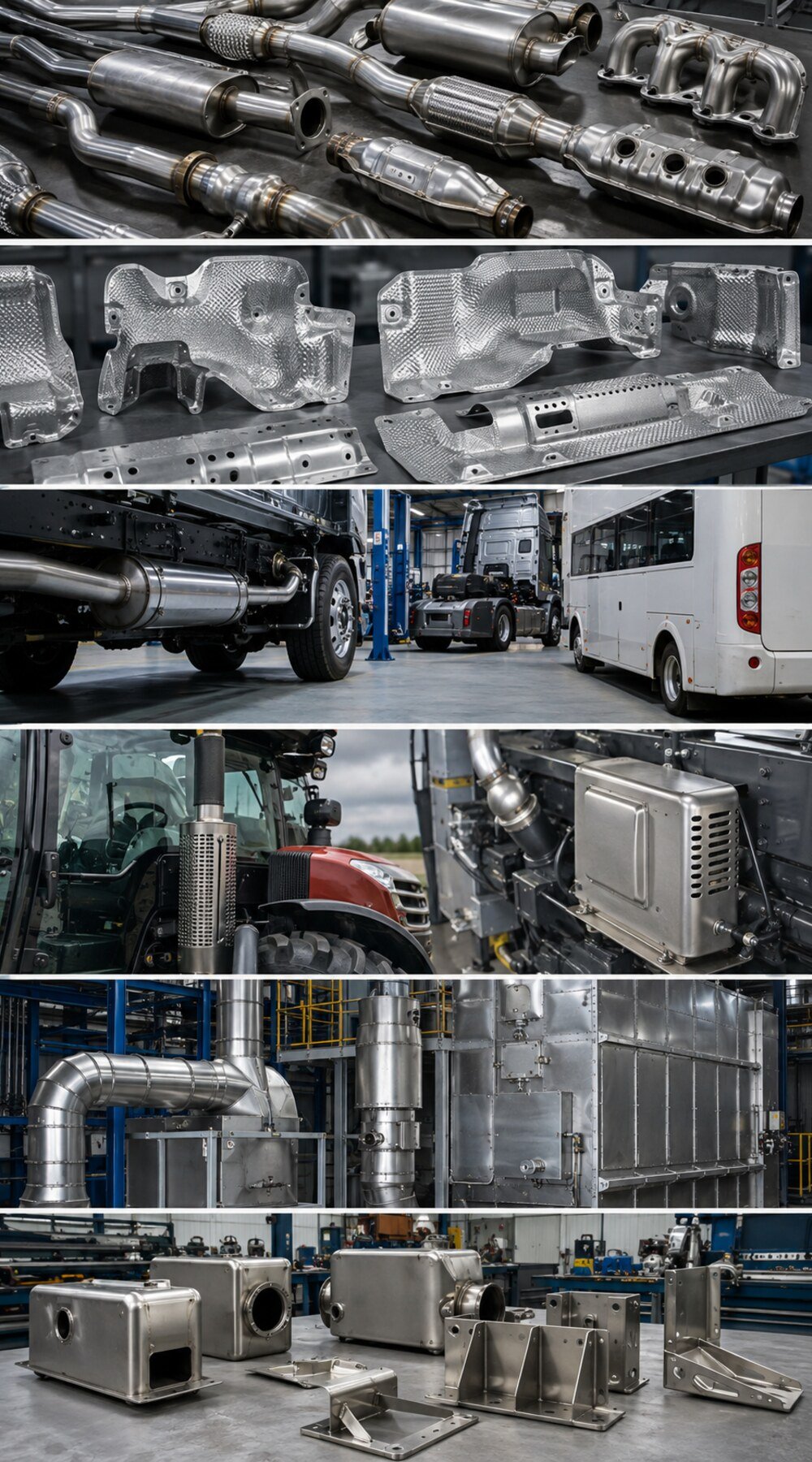
Automotive Exhaust Systems
The primary applications include exhaust pipes, mufflers, resonators, catalytic-converter shells, manifolds, and related exhaust components.
Heat Shields and Thermal Components
Its oxidation resistance and relatively low thermal expansion make it suitable for automotive and industrial heat shields.
Commercial and Heavy Vehicles
SUS 409L is used in truck, bus, agricultural vehicle, and heavy-equipment exhaust systems.
Agricultural Equipment
Applications include exhaust components, guards, housings, brackets, and fabricated parts exposed to moderate heat and corrosive conditions.
Industrial Exhaust and Furnace Components
Selected uses include exhaust ducts, silencers, burner components, furnace parts, and enclosures exposed to compatible gases and temperatures.
General Fabricated Components
SUS 409L may be used for containers, brackets, structural covers, and equipment components where moderate corrosion resistance and low cost are acceptable.
faq
Stainless Steel CSP Material FAQ
SUS 409L is a low-carbon, titanium-stabilized ferritic stainless steel used primarily for automotive exhaust systems and heat-cycling components.
Titanium stabilizes carbon and nitrogen, helping reduce sensitization and improve welding and heat-affected-zone performance.
Yes. Automotive exhaust pipes, mufflers, catalytic-converter components, and heat shields are its primary applications.
Generally, it is not the preferred grade for aggressive chemical-processing environments. The actual chemicals, concentrations, temperatures, and exposure conditions must be evaluated.
SUS 439 contains more chromium and generally provides better corrosion resistance and elevated-temperature performance, but it usually costs more.
Take Action