
STAINLESS STEEL FOR APPLIANCE AND CONSUMER-PRODUCT MANUFACTURING
Stainless Steel for Home Appliances & Consumer Products
Genn-Hann supplies stainless steel coil, sheet and precision strip for appliance housings, kitchen products, heating components, internal structures and precision-formed consumer-product parts. Customized grades, dimensions and surface finishes support manufacturers requiring corrosion resistance, durability, formability and consistent visual appearance.
Industry Introduction
Why Stainless Steel Is Used in Home Appliances and Consumer Products
Stainless steel combines corrosion resistance, durability, cleanability and a modern appearance, making it suitable for visible appliance surfaces and functional internal components. It can be stamped, deep drawn, formed, welded, polished and assembled into products ranging from kitchen appliances and laundry equipment to heating systems and consumer hardware.
Material selection depends on the component’s function, moisture and chemical exposure, operating temperature, forming requirements, magnetic characteristics, surface appearance and production cost. Visible exterior panels and internal structural or heat-exposed components may therefore require different stainless steel grades, thicknesses and finishes.
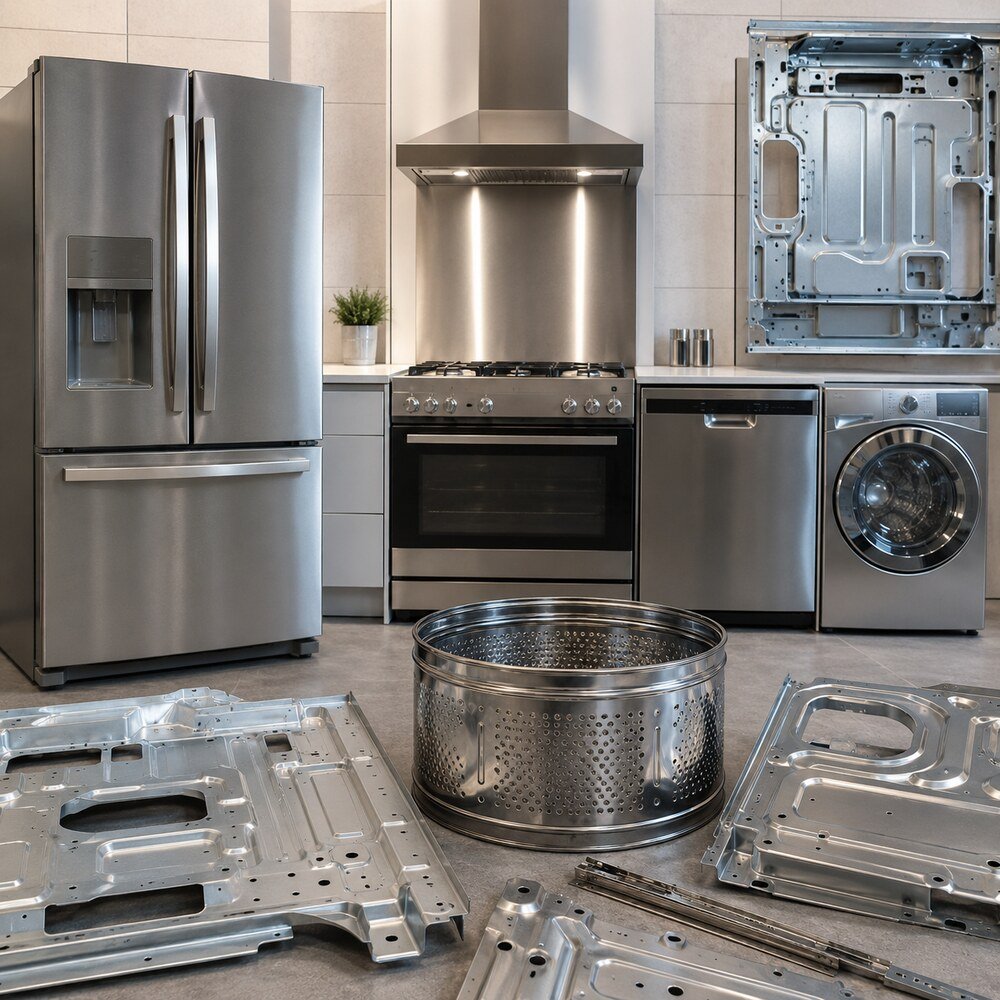
FROM EXTERIOR PANELS TO PRECISION INTERNAL COMPONENTS
Stainless Steel Applications for Home Appliances and Consumer Products
SELECT GRADES ACCORDING TO FUNCTION, APPEARANCE AND PRODUCTION NEEDS
Stainless Steel Grades for Home Appliances and Consumer Products
Appliance material selection should balance corrosion resistance, formability, weldability, magnetic properties, temperature exposure, surface appearance and production cost. Visible exterior panels, water-contact parts, heating components and precision springs may require different grades, tempers and finishes.
| Stainless Steel Grade | Recommended Positioning | Grade Details |
|---|---|---|
| SUS 304 / 304L | A versatile option for general industrial tanks, equipment panels, cabinets, guards, hoppers, frames and fabricated components used with compatible chemicals and operating environments. The low-carbon 304L grade may be preferred for welded fabrication. | |
| SUS 316 / 316L | Considered for components exposed to more demanding chemical, chloride-containing or humid industrial environments. Molybdenum improves resistance to localized pitting and crevice corrosion, but compatibility must still be verified against the actual process medium. | SUS 316L → |
| SUS 430 | A cost-conscious ferritic option for selected indoor enclosures, panels, guards and non-wetted industrial components where the required corrosion resistance, temperature performance and fabrication characteristics permit its use. | View grade → |
| SUS 409L / 439L | Stabilized ferritic grades that may be evaluated for selected heat-exposed, exhaust, ventilation and industrial components requiring oxidation resistance, weldability or controlled thermal expansion. Chemical-contact suitability requires separate verification. | |
| SUS 301 | Suitable for selected precision strip, spring, clip, clamp and formed-component applications requiring higher strength through cold working, controlled temper and elastic recovery. | No grade page |
| CSP Material | Suitable for precision-formed industrial components requiring controlled hardness, spring characteristics, dimensional consistency or mechanical performance. Grade and temper should be defined according to the component design. | View material → |
Available Stainless Steel Material Forms
Stainless Steel Strip
Cold rolled stainless steel precision strips for stamping, electronics components, springs, clips, brackets, clamps, fasteners, and small metal parts.
Stainless Steel Coil
Cold rolled and hot rolled stainless steel coils for slitting, cutting, polishing, and customized downstream processing. Suitable for manufacturers that need stable material supply, flexible dimensions, and consistent surface quality.
Stainless Steel Sheet
Cold rolled stainless steel sheets and hot rolled stainless steel plates for panels, covers, machinery parts, appliance components, fabrication, and visible stainless steel products.
Cold Rolled Stainless Steel Hardness CSP material
Cold rolled stainless steel hardness CSP material for applications that require strength, elasticity, hardness stability, and precision performance, such as springs, clips, terminals, brackets, electronics components, and precision stamped parts.
CUSTOMIZED DIMENSIONS AND FINISHES FOR APPLIANCE PRODUCTION
Precision Stainless Steel Processing for Appliance Manufacturing
Material Prepared for Repeatable Manufacturing
Surface Options for Visible and Functional Components
Why Chemical and Industrial Equipment Manufacturers Choose Genn-Hann
Industrial equipment manufacturers require stainless steel with clearly defined grades, dimensions, surface conditions and processing requirements. Genn-Hann combines material-selection support, customized processing, production control and flexible material supply to support chemical-processing equipment and general industrial fabrication.
Material Selection Support
Guidance on stainless steel grades, material forms, dimensions, hardness and finishes based on component function, appearance and fabrication requirements.
Customized Processing
Precision slitting, cut-to-length sheet processing and polishing for customized thickness, width, length and surface specifications.
Decorative Surface Options
Selected 2B, BA, No.3, No.4, hairline and SB finishes support exterior appliance panels, decorative housings and functional internal components.
Quality-Controlled Production
Inspection equipment, production monitoring and documented process control help maintain dimensional and surface consistency across repeat orders.
Automated Warehousing and ERP Control
Integrated inventory and order management support material identification, production tracking, processing coordination and repeat-order control.
Flexible Material Supply
Access to 200, 300 and 400-series stainless steel in coil, sheet, precision strip and CSP material forms for different component requirements.
Global Delivery Support
Export experience and flexible land, sea and air logistics support appliance and consumer-product manufacturers across international supply chains.
Information to Provide When Requesting Stainless Steel
Complete Specifications Help Us Recommend the Right Material and Processing Solution
Providing complete technical and commercial requirements allows Genn-Hann to review material suitability, confirm processing capabilities and prepare a more accurate quotation. Include the intended application, stainless steel grade, dimensions, tolerances, surface requirements, order quantity and delivery destination whenever possible.
Intended Application
Describe the component, equipment or operating environment in which the stainless steel will be used.
Stainless Steel Grade
Specify the required grade, such as SUS 304, 304L, 316L, 301, 430 or another customer-approved material.
Applicable Material Standard
Include the required ASTM, JIS, EN or customer-specific material standard when applicable.
Product Form
Indicate whether the material is required as stainless steel coil, sheet, precision strip or CSP material.
Dimensions and Tolerances
Provide the required thickness, width, length and acceptable dimensional tolerances.
Temper or Hardness
State the required temper, hardness range or mechanical-property requirements for formed or spring components.
Surface Finish
Specify the required surface condition or finish, such as 2B, BA, No.3, No.4, Hairline or SB.
Edge and Flatness Requirements
Include any requirements for slit-edge condition, burr control, flatness, sheet shape or coil configuration.
Surface Protection and Packaging
Identify protective-film, paper-interleaving, moisture protection, labeling or export-packaging requirements.
Fabrication Method
Explain whether the material will be stamped, formed, welded, polished, laser cut or processed using another manufacturing method.
Order Quantity
Provide the estimated quantity, preferred coil weight, sheet count or expected recurring demand.
Delivery Requirements
Include the destination country, requested delivery date and any preferred shipping or documentation requirements.
Need help preparing your specification? Send the available drawings, material requirements or application details to Genn-Hann for review. Contact our material specialists.
faq
Frequently Asked Questions About Stainless Steel Home Appliances & Consumer Products
01 Which stainless steel grade is most commonly used for home appliances?
SUS 304 is widely used for kitchen appliances, dishwasher components, refrigerator panels, containers and fabricated parts requiring corrosion resistance and formability.
SUS 430 is commonly considered for cost-sensitive decorative panels, housings and selected heat-area components. The correct grade depends on the component’s function, exposure and manufacturing process.
02 What is the difference between SUS 304 and SUS 430 for appliances?
SUS 304 is an austenitic grade that generally provides better corrosion resistance and fabrication versatility. SUS 430 is a ferritic, magnetic grade offering an economical option for selected indoor and decorative components.
They should not be treated as direct substitutes without reviewing corrosion exposure, forming severity, welding, appearance and magnetic requirements.
03 When should SUS 316L be considered for an appliance component?
SUS 316L may be considered for selected components exposed to more demanding moisture, chloride-containing cleaners, salt or chemical environments.
Its molybdenum content improves resistance to localized corrosion in many chloride environments, but compatibility must still be verified against the actual product and operating conditions.
04 Is all stainless steel non-magnetic?
No. Ferritic grades such as SUS 430, 409L and 439 are magnetic. Austenitic grades such as annealed SUS 304 and 316L generally have low magnetic response, but cold forming can increase their magnetic response.
Magnetic performance should be specified and tested when it affects sensors, motors, closures, induction heating or product functionality.
05 Which stainless steel grades work with induction cooking?
Induction cooking requires a cookware base with suitable ferromagnetic characteristics. Ferritic stainless steels can support this function, while some austenitic stainless steels may not couple efficiently with the induction field by themselves.
Cookware commonly uses multilayer construction to combine induction response, heat distribution and corrosion resistance. Performance must be validated in the finished product.
06 Why is formability important for appliance stainless steel?
Appliance components are often stamped, bent, stretched or deep drawn into doors, tubs, drums, containers and housings. Inconsistent mechanical properties can contribute to splitting, wrinkling, springback or dimensional variation.
The grade, temper, thickness tolerance, grain direction, tooling, lubrication and forming sequence must be matched to the component geometry.
07 What causes springback during stainless steel forming?
Springback occurs when elastic stress is released after bending or forming, causing the component to move away from the tool geometry.
Its severity depends on grade, temper, yield strength, thickness, bend radius and tooling. Material consistency and properly developed forming tools help control the final dimensions.
08 Which surface finishes are used for appliance panels?
BA, No.4, hairline, SB and other specified finishes may be used for refrigerator doors, oven panels, control surrounds, housings and decorative consumer products. A 2B finish is often used for functional internal components.
The required finish should be defined using an approved sample because appearance can vary with polishing method, grain direction, forming and lighting.
09 Why must grain direction be controlled on visible appliance panels?
Directional finishes reflect light differently according to grain orientation. Mixing grain directions across adjacent panels can create a visible mismatch in color, brightness and texture.
Drawings and purchase specifications should identify the required polishing direction relative to the finished component.
10 What is fingerprint-resistant stainless steel?
Fingerprint-resistant stainless steel generally uses a transparent surface treatment or coating designed to reduce the visibility of fingerprints and make routine cleaning easier.
Coating appearance, forming limits, adhesion, heat resistance, chemical resistance and cleaning compatibility should be confirmed before production.
11 Why is protective film applied to decorative stainless steel sheet?
Protective film helps reduce scratching, fingerprints and handling damage during slitting, cutting, stamping, forming, transportation and assembly.
The film must be compatible with the surface finish and fabrication process. Adhesion level, removal timing, storage temperature and heat exposure should be specified.
12 Why can stainless steel appliance components develop rust marks?
Rust marks can result from carbon-steel contamination, chloride-containing cleaners, salt deposits, damaged surfaces, poor drainage, unsuitable grade selection or incomplete post-weld cleaning.
Stainless steel is corrosion resistant, not corrosion proof. The source of the discoloration should be identified before selecting a cleaning or corrective procedure.
13 Can stainless steel be used for food- or water-contact appliance parts?
Appropriate stainless steel grades are widely used for food- and water-contact components. Suitability depends on the grade, surface condition, fabrication quality, food or water chemistry, temperature, contact time and cleaning process.
The finished component must meet the appliance manufacturer’s safety, migration, sanitation and regulatory requirements.
14 Which stainless steel is used for appliance springs and clips?
SUS 301 and other CSP materials are commonly considered for springs, clips, retainers and fastening components requiring controlled hardness, strength and elastic recovery.
The grade, temper, thickness, forming direction and edge condition should be selected according to the required load, deflection, fatigue life and manufacturing process.
15 What information should be provided when ordering appliance stainless steel?
Provide the grade, temper, product form, thickness, width, length, tolerances, surface finish, grain direction, edge condition, flatness and protective-film requirements.
Also identify the component application, forming method, operating environment, quantity, packaging, approved finish sample and required material certificates.
Take Action