
Precision-Processed Stainless Steel for Clean, Reliable and Consistent Production
Stainless Steel for Semiconductor & High-Tech Manufacturing
Genn-Hann supplies precision stainless steel coil, sheet and strip for semiconductor equipment, electronic manufacturing systems, cleanroom infrastructure and other high-tech industrial applications. With customizable dimensions, controlled surface finishes and precision slitting and cutting, we help component manufacturers select materials suited to corrosion resistance, cleanliness, formability and dimensional consistency requirements.
Industry Introduction
Why Stainless Steel Is Used in Semiconductor Manufacturing
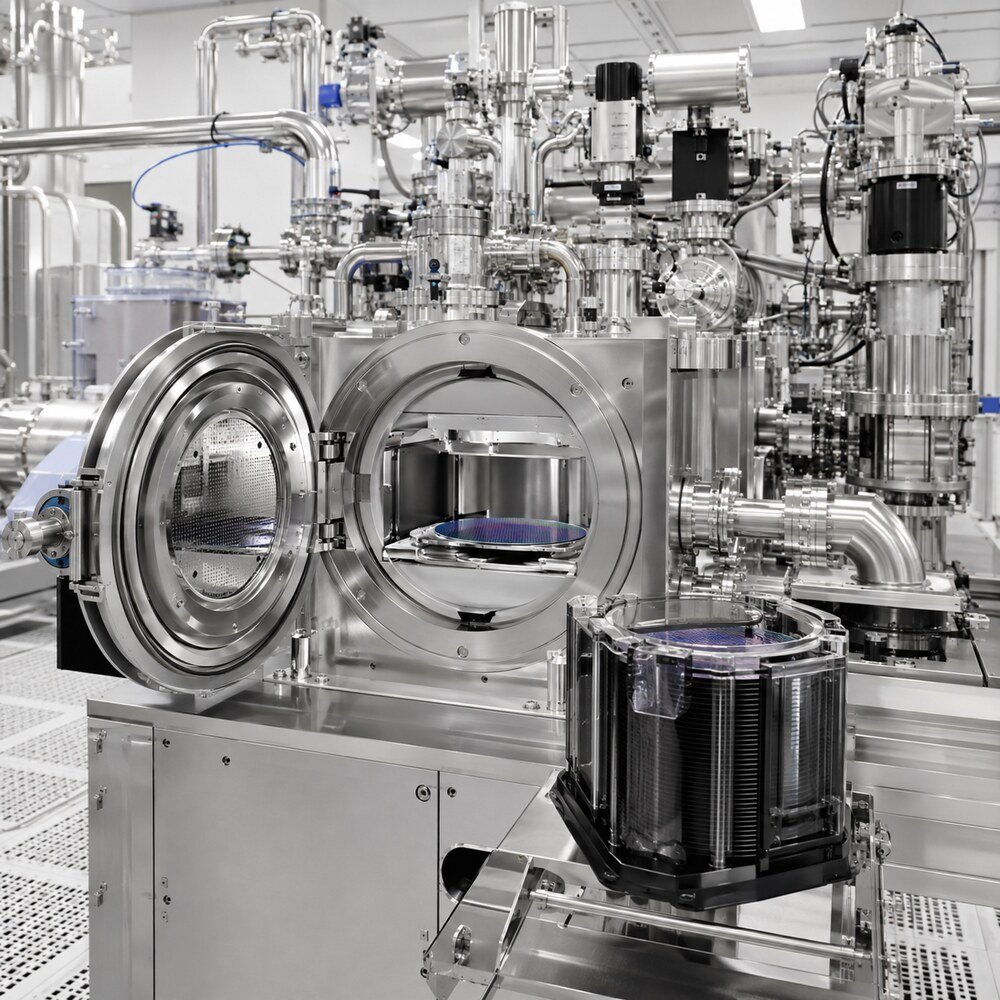
Semiconductor and high-tech manufacturing environments depend on materials that support cleanliness, corrosion resistance, dimensional stability and reliable operation. Stainless steel is commonly specified for equipment enclosures, machine panels, cleanroom fixtures, process-support structures and selected gas or chemical-handling components.
The correct material depends on the component’s exposure conditions, fabrication method, surface requirements and applicable technical specifications. Genn-Hann supports equipment manufacturers and precision fabricators with stainless steel coil, sheet and strip processed to customized thicknesses, widths, lengths and surface finishes.
Application Breakdown
Stainless Steel Applications in Semiconductor and High-Tech Equipment
Precision stainless steel sheet and strip support clean, durable and dimensionally consistent components throughout advanced manufacturing environments.
| Application | Typical Uses |
|---|---|
|
01
Equipment Enclosures and Machine Panels
|
Stainless steel sheet can be fabricated into protective cabinets, access panels, machine covers and exterior housings for semiconductor and electronics production equipment. |
|
02
Cleanroom Fixtures and Workstations
|
Stainless steel supports cleanable work surfaces, storage systems, carts, partitions and selected cleanroom infrastructure components. |
|
03
Equipment Frames and Structural Components
|
Precision-cut sheet and strip can be used for brackets, internal supports, mounting structures and fabricated equipment frames. |
|
04
Gas and Chemical Delivery Support Systems
|
Appropriate stainless steel grades may be used for selected cabinets, trays, supports, housings and components associated with gas or chemical delivery systems. |
|
05
Vacuum and Process Equipment Components
|
Stainless steel may be selected for fabricated covers, shields, brackets and supporting components used around vacuum and process equipment. |
|
06
Precision Electronic Manufacturing Equipment
|
Stainless steel strip and sheet can support housings, springs, clips, brackets, shielding components and production automation equipment. |
Compare Stainless Steel Grades for Corrosion Resistance, Formability and Precision Fabrication
Stainless Steel Grades for Semiconductor Equipment Components
Material selection for semiconductor equipment depends on the component’s function, operating environment, chemical exposure, fabrication method and surface requirements. Genn-Hann supplies a range of stainless steel grades and CSP materials for equipment panels, enclosures, cleanroom fixtures, precision-formed parts and supporting components.
| Stainless Steel Grade | Typical Positioning for Semiconductor Equipment |
|---|---|
| SUS 304 → / SUS 304L → | A versatile option for equipment panels, enclosures, cleanroom fixtures, work surfaces and general fabricated components requiring good corrosion resistance and formability. |
| SUS 316 / 316L → | Considered for components exposed to more demanding chemical or chloride-containing environments. Final suitability should be verified against the operating medium and applicable specification. |
| SUS 301 → | Suitable for selected precision strip, spring, clip and formed-component applications requiring higher strength through cold working. |
| SUS 430 → | A cost-conscious ferritic option for selected indoor covers, panels and equipment components where the specified corrosion and fabrication requirements permit. |
| CSP Material → | Suitable for precision-formed components requiring controlled hardness, spring characteristics or dimensional consistency. |
| Technical note: Grade selection should be based on chemical exposure, operating temperature, required surface condition, fabrication method, mechanical properties and customer specifications. Contact Genn-Hann for material-selection support. | |
| Capability | Processing Range | Manufacturing Benefit |
|---|---|---|
| Material Thickness | 0.10–6.00 mm |
Supports thin precision components, general sheet-metal fabrication and heavier equipment structures across a wide range of production requirements. |
| Precision Slitting Width | Down to 4 mm |
Narrow stainless steel strip can support precision stamping, springs, clips, brackets and other small formed components. |
| Coil Width | Up to 1,600 mm |
Wide-coil capability supports larger panels, equipment housings and efficient material conversion for high-volume production. |
| Shearing Length | Up to 6,000 mm |
Long cut-to-length sheets can reduce additional processing for equipment panels, structural sections and fabricated assemblies. |
| Precision Coil Slitting | Customized |
Precision slitting prepares stainless steel coil to the widths required for stamping, forming and continuous production processes. |
| Sheet Cutting | Cut to Length |
Controlled cut-to-length processing helps manufacturers receive sheet dimensions suited to downstream fabrication and assembly. |
| Surface Polishing | No.3, No.4, HL, SB |
Controlled surface-finishing options support equipment components requiring consistent appearance, surface texture or cleanability. |
| Stainless Steel Series | 200 / 300 / 400 |
Multiple stainless steel families allow material selection based on corrosion resistance, mechanical properties, formability and cost considerations. |
| Material and Order Control | ERP Supported |
Automated warehousing and ERP-supported order management help improve inventory visibility, processing control and delivery coordination. |
Processing note: Available dimensions, tolerances, finishes and protective-film options depend on the selected stainless steel grade, temper, material form, processing line and order specification. Confirm final requirements with Genn-Hann before ordering.
Why High-Tech Manufacturers Choose Genn-Hann
Genn-Hann combines stainless steel expertise, precision processing, quality-controlled production and inventory support to help high-tech manufacturers manage material consistency and procurement requirements. From grade selection and customized dimensions to surface finishing and international delivery, each order is prepared around the customer’s manufacturing specifications.
Material Selection Support
Guidance on stainless steel grades, product forms, finishes and dimensions based on the component’s intended use and fabrication requirements.
Customized Processing
Precision slitting, cut-to-length sheet processing and polishing for customized thickness, width, length and surface specifications.
Quality-Controlled Production
Inspection equipment, production monitoring and documented process control help maintain dimensional and surface consistency.
Automated Warehousing and ERP Control
Integrated inventory and order management improve material tracking, processing coordination and response times.
Flexible Material Supply
Access to 200, 300 and 400-series stainless steel in coil, sheet, strip and CSP material forms.
Global Delivery Support
Export experience and flexible land, sea and air logistics support customers across international manufacturing supply chains.
Information to Provide When Requesting Stainless Steel
Complete Specifications Help Us Recommend the Right Material and Processing Solution
Providing complete technical and commercial requirements allows Genn-Hann to review material suitability, confirm processing capabilities and prepare a more accurate quotation. Include the intended application, stainless steel grade, dimensions, tolerances, surface requirements, order quantity and delivery destination whenever possible.
Intended Application
Describe the component, equipment or operating environment in which the stainless steel will be used.
Stainless Steel Grade
Specify the required grade, such as SUS 304, 304L, 316L, 301, 430 or another customer-approved material.
Applicable Material Standard
Include the required ASTM, JIS, EN or customer-specific material standard when applicable.
Product Form
Indicate whether the material is required as stainless steel coil, sheet, precision strip or CSP material.
Dimensions and Tolerances
Provide the required thickness, width, length and acceptable dimensional tolerances.
Temper or Hardness
State the required temper, hardness range or mechanical-property requirements for formed or spring components.
Surface Finish
Specify the required surface condition or finish, such as 2B, BA, No.3, No.4, Hairline or SB.
Edge and Flatness Requirements
Include any requirements for slit-edge condition, burr control, flatness, sheet shape or coil configuration.
Surface Protection and Packaging
Identify protective-film, paper-interleaving, moisture protection, labeling or export-packaging requirements.
Fabrication Method
Explain whether the material will be stamped, formed, welded, polished, laser cut or processed using another manufacturing method.
Order Quantity
Provide the estimated quantity, preferred coil weight, sheet count or expected recurring demand.
Delivery Requirements
Include the destination country, requested delivery date and any preferred shipping or documentation requirements.
Need help preparing your specification? Send the available drawings, material requirements or application details to Genn-Hann for review. Contact our material specialists.
faq
Frequently Asked Questions About Stainless Steel for Semiconductor Manufacturing
Why is 316L stainless steel widely used in semiconductor manufacturing?
316L offers good corrosion resistance, weldability and cleanability. Its molybdenum content improves resistance to localized corrosion compared with 304, while its low carbon content reduces sensitization after welding. However, 316L is not automatically suitable for every semiconductor process environment.
What is the difference between 316 and 316L stainless steel?
The principal difference is carbon content. Standard specifications generally permit up to 0.08% carbon in 316, while 316L is limited to 0.03%. The lower carbon content reduces chromium-carbide precipitation and helps preserve corrosion resistance around welded areas.
What is SEMI F20?
SEMI F20 specifies composition and metallurgical-cleanliness requirements for 316L stainless steel used to manufacture components for general-purpose, high-purity and ultra-high-purity semiconductor gas or liquid distribution systems. It covers specified forms such as plate, tubing, bar, forgings and extruded shapes.
Is standard industrial 316L automatically compliant with SEMI F20?
No. Meeting the basic chemistry requirements of 316L does not establish SEMI F20 compliance. Compliance requires the specified material form, purity classification, metallurgical-cleanliness controls, testing and traceable documentation.
Can 304 stainless steel be used in semiconductor equipment?
Yes. 304 and 304L can be suitable for equipment panels, cabinets, frames, workstations, carts and other non-wetted components. They should not be treated as equivalent to qualified 316L for corrosive or ultra-high-purity process-contact applications.
Why does 316L resist localized corrosion better than 304?
316L normally contains approximately 2–3% molybdenum. This improves resistance to pitting and crevice corrosion in many chloride-bearing environments. Actual performance still depends on chloride concentration, temperature, pH, surface condition and component geometry.
Why are sulfur and non-metallic inclusions controlled in semiconductor-grade steel?
Sulfur-bearing inclusions can affect surface quality, polishing consistency and corrosion behavior. High-purity specifications may impose tighter sulfur and inclusion controls than standard commercial 316L. The required limits must come from the specified SEMI classification or customer specification.
What is 316L VIM-VAR?
VIM-VAR refers to vacuum induction melting followed by vacuum arc remelting. These processes can improve alloy cleanliness and control inclusions, but VIM-VAR is not automatically required for every semiconductor component. It must be explicitly required by the material or equipment specification.
Does standard 316L coil or sheet qualify as VIM-VAR or ultra-high-purity material?
It should not be represented as VIM-VAR, SEMI F20 or ultra-high-purity material unless the specific heat, product and order documentation establish that compliance. Standard 316L grade identification alone is insufficient.
What is electropolishing?
Electropolishing is an electrochemical process that removes a controlled surface layer and smooths microscopic peaks. For qualified high-purity components, it can improve cleanability and reduce locations where particles or contaminants accumulate. It is a finished-component process, not simply a mill-finish designation.
How does passivation differ from electropolishing?
Electropolishing physically removes and smooths a thin surface layer. Passivation chemically removes free iron and promotes formation of a corrosion-resistant passive surface. The two processes are different and may be specified separately or together.
What surface roughness is required for semiconductor wetted components?
There is no single roughness requirement for every semiconductor component. High-purity and ultra-high-purity specifications may require electropolished surfaces with tightly controlled Ra values, but the limit must be taken from the equipment, component or customer specification.
Are 2B, BA, No.4, Hairline and SB finishes suitable for semiconductor equipment?
These finishes may be appropriate for panels, enclosures, frames, cabinets and other non-critical surfaces. They should not automatically be specified for high-purity wetted surfaces, which may require controlled roughness, electropolishing, passivation, specialized cleaning and documented packaging.
Can 316L be used in direct contact with hydrofluoric acid?
316L generally has poor resistance to hydrofluoric acid and should not be selected for sustained direct contact without application-specific corrosion data. Concentration, temperature, exposure duration and contamination can materially change performance. Final alloy selection requires qualified corrosion review.
Is 316L suitable for hydrochloric acid service?
Take Action