
Precision Coil, Sheet and Strip for Exhaust, Stamping, Forming and Vehicle Component Manufacturing
Stainless Steel for Automotive Components
Genn-Hann supplies stainless steel coil, sheet, precision strip and CSP materials for automotive exhaust parts, heat shields, brackets, clamps, trim, springs and other stamped or formed components. Customized slitting, cutting, hardness and surface options help component manufacturers manage dimensional consistency, forming performance and repeatable production quality.
Industry Introduction
Why Stainless Steel Is Used in Automotive Components
Automotive components may be exposed to heat, condensation, road salts, moisture, vibration and repeated thermal cycling. Appropriate stainless steel grades can provide useful oxidation resistance, corrosion resistance and fabrication performance for exhaust components, heat shields, brackets and other vehicle parts.
Stainless steel coil, sheet and strip can be stamped, formed, welded and fabricated into complex components. Controlled thickness, width, hardness and surface condition help manufacturers maintain repeatable feeding, forming and assembly across high-volume production.
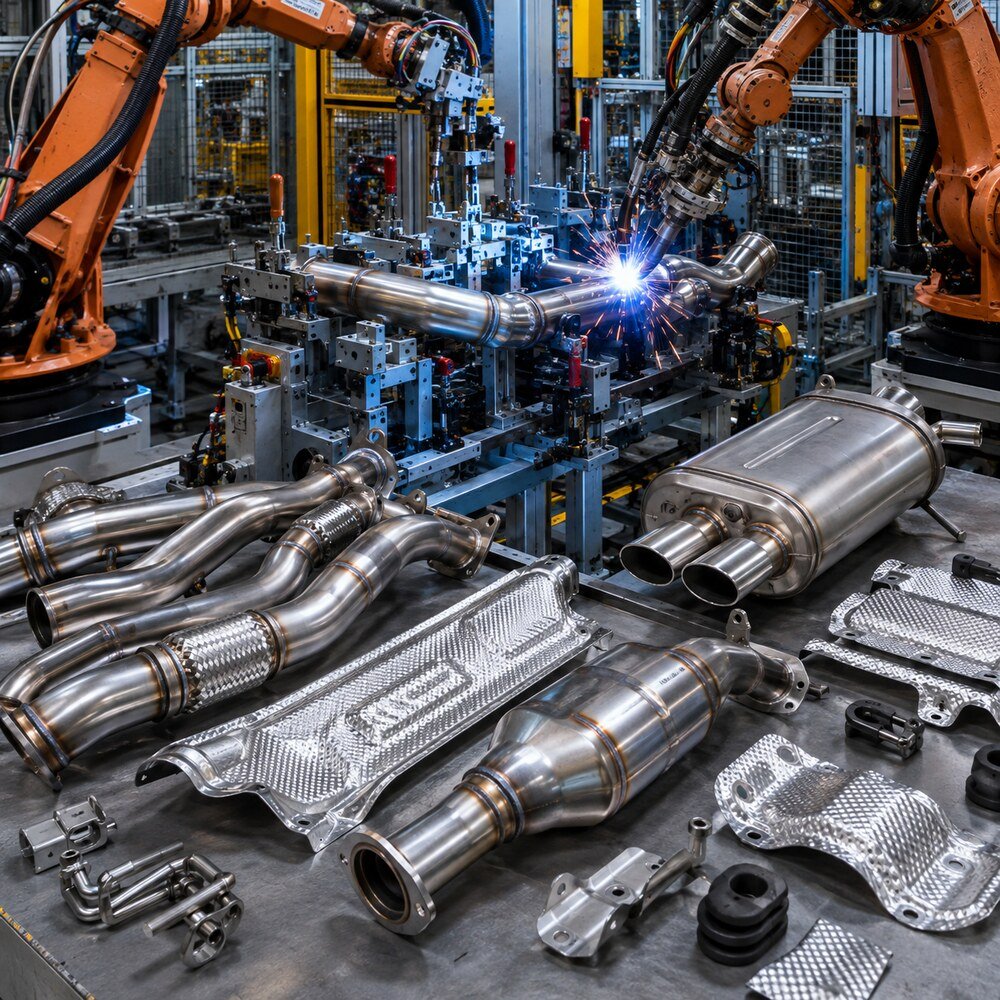
Material Solutions for Exhaust Systems, Heat Management, Precision Stampings and Vehicle Trim
Stainless Steel Applications in Automotive Components
Stainless steel is used in automotive components that require corrosion resistance, oxidation resistance, strength, formability or a durable surface. The correct grade depends on component location, operating temperature, condensate chemistry, road-salt exposure, forming method and expected service life.
| Automotive Application | Typical Uses |
|---|---|
|
01
Exhaust System Components
|
SUS 409L and SUS 439 may be considered for selected exhaust pipes, muffler shells, resonators, catalytic-converter shells and related components requiring oxidation resistance, weldability and cost control. |
|
02
Heat Shields and Thermal Barriers
|
Thin stainless steel sheet can be stamped or formed into heat shields and protective barriers around exhaust, engine and underbody heat sources. |
|
03
Brackets, Clamps and Mounting Components
|
Precision strip and sheet support brackets, clamps, hangers, mounting tabs and reinforcement components requiring consistent forming and dimensional control. |
|
04
Automotive Trim and Decorative Parts
|
SUS 304, SUS 430 and other suitable grades may be used for visible trim, sill plates, interior accents and decorative components requiring durability and a controlled surface appearance. |
|
05
Springs, Clips and Retention Components
|
SUS 301 and CSP materials can support clips, springs, retainers and fastening components requiring controlled hardness, elastic recovery and strength. |
|
06
EV and Electrified Vehicle Components
|
Stainless steel may support selected battery-system brackets, protective covers, sensor housings, cable-management parts and electronic equipment structures, subject to vehicle and component specifications. |
Technical reference: Stabilized ferritic grades such as 409 and 439 are established material options for selected automotive exhaust applications. View automotive-grade guidance .
Compare Materials for Exhaust Performance, Formability, Corrosion Resistance and Cost
Stainless Steel Grades for Automotive Components
Automotive stainless steel selection depends on component location, temperature, corrosion exposure, forming method, welding requirements, mechanical loading and appearance. Stabilized ferritic grades are commonly considered for exhaust-system components, while austenitic and CSP materials support trim, brackets, springs and precision stampings.
| Grade or Material | Typical Positioning for Electronics and Precision Components |
|---|---|
| SUS 301 | Commonly considered for springs, clips, clamps and formed components that require higher strength through cold working. Temper and hardness must be matched to the forming and spring requirements. |
| SUS 304 → / SUS 304L → | Versatile materials for housings, brackets, connector shells, covers and general precision components requiring corrosion resistance, formability and a durable surface. |
| SUS 316 / SUS 316L → | Considered for components exposed to more demanding chemical, chloride-bearing or humid environments. Suitability must be evaluated against the actual operating conditions. |
| SUS 430 → | A cost-conscious ferritic grade for selected housings, covers, brackets and magnetic components where its corrosion resistance and forming characteristics meet the application requirements. |
| SUS 201 / 202 → | Alternative austenitic grades for selected stamped and formed components where the required mechanical properties, corrosion exposure, fabrication method and cost targets are compatible. |
| CSP Material → | Cold-rolled stainless steel supplied in controlled hardness conditions for springs, clips and precision-formed components requiring defined strength or elastic behavior. |
| Technical note: Material selection should account for mechanical loading, forming method, springback, fatigue requirements, corrosion exposure, magnetic response, surface finish, plating and customer specifications. Contact Genn-Hann for material-selection support. | |
Available Stainless Steel Material Forms
Stainless Steel Strip
Cold rolled stainless steel precision strips for stamping, electronics components, springs, clips, brackets, clamps, fasteners, and small metal parts.
Stainless Steel Coil
Cold rolled and hot rolled stainless steel coils for slitting, cutting, polishing, and customized downstream processing. Suitable for manufacturers that need stable material supply, flexible dimensions, and consistent surface quality.
Stainless Steel Sheet
Cold rolled stainless steel sheets and hot rolled stainless steel plates for panels, covers, machinery parts, appliance components, fabrication, and visible stainless steel products.
Cold Rolled Stainless Steel Hardness CSP material
Cold rolled stainless steel hardness CSP material for applications that require strength, elasticity, hardness stability, and precision performance, such as springs, clips, terminals, brackets, electronics components, and precision stamped parts.
Customized Stainless Steel Slitting, Cutting and Surface Finishing for Consistent Downstream Production
Precision Processing for High-Tech Manufacturing Supply Chains
Control Quality from the Material Stage
Precision Strip for High-Tech Component
| Capability | Processing Range | Benefit for Automotive Manufacturing |
|---|---|---|
| Material Thickness | 0.10–6.00 mm |
Supports thin heat shields and clips through to heavier brackets, covers and fabricated vehicle components. |
| Precision Slitting Width | Down to 4 mm |
Supports narrow springs, clips, clamps, retainers and other precision-stamped automotive components. |
| Coil Width | Up to 1,600 mm |
Provides flexibility for high-volume stamping, shell production and larger fabricated automotive parts. |
| Shearing Length | Up to 6,000 mm |
Supports heat shields, panels, covers and longer fabricated vehicle components. |
| Precision Coil Slitting | Customized |
Prepares stainless steel coil to specified widths for progressive stamping, roll forming and automated feeding. |
| Sheet Cutting | Cut to Length |
Supplies sheet dimensions suited to forming, welding and automotive-component assembly. |
| Surface Polishing | No.3, No.4, HL, SB |
Supports visible trim and decorative automotive components requiring a controlled and consistent surface appearance. |
| Stainless Steel Series | 200 / 300 / 400 |
Enables material selection based on temperature, corrosion resistance, formability, magnetic response and cost. |
| Material and Order Control | ERP Supported |
Supports recurring orders, inventory visibility, processing coordination and supply continuity. |
Processing note: Available dimensions, tolerances, hardness conditions, edge quality, surface finishes and protective-film options depend on the selected grade, product form, processing line and order specification.
Why High-Tech Manufacturers Choose Genn-Hann
Genn-Hann combines stainless steel expertise, precision processing, quality-controlled production and inventory support to help high-tech manufacturers manage material consistency and procurement requirements. From grade selection and customized dimensions to surface finishing and international delivery, each order is prepared around the customer’s manufacturing specifications.
Material Selection Support
Guidance on stainless steel grades, product forms, finishes and dimensions based on the component’s intended use and fabrication requirements.
Customized Processing
Precision slitting, cut-to-length sheet processing and polishing for customized thickness, width, length and surface specifications.
Quality-Controlled Production
Inspection equipment, production monitoring and documented process control help maintain dimensional and surface consistency.
Automated Warehousing and ERP Control
Integrated inventory and order management improve material tracking, processing coordination and response times.
Flexible Material Supply
Access to 200, 300 and 400-series stainless steel in coil, sheet, strip and CSP material forms.
Global Delivery Support
Export experience and flexible land, sea and air logistics support customers across international manufacturing supply chains.
Information to Provide When Requesting Stainless Steel
Complete Specifications Help Us Recommend the Right Material and Processing Solution
Providing complete technical and commercial requirements allows Genn-Hann to review material suitability, confirm processing capabilities and prepare a more accurate quotation. Include the intended application, stainless steel grade, dimensions, tolerances, surface requirements, order quantity and delivery destination whenever possible.
Intended Application
Describe the component, equipment or operating environment in which the stainless steel will be used.
Stainless Steel Grade
Specify the required grade, such as SUS 304, 304L, 316L, 301, 430 or another customer-approved material.
Applicable Material Standard
Include the required ASTM, JIS, EN or customer-specific material standard when applicable.
Product Form
Indicate whether the material is required as stainless steel coil, sheet, precision strip or CSP material.
Dimensions and Tolerances
Provide the required thickness, width, length and acceptable dimensional tolerances.
Temper or Hardness
State the required temper, hardness range or mechanical-property requirements for formed or spring components.
Surface Finish
Specify the required surface condition or finish, such as 2B, BA, No.3, No.4, Hairline or SB.
Edge and Flatness Requirements
Include any requirements for slit-edge condition, burr control, flatness, sheet shape or coil configuration.
Surface Protection and Packaging
Identify protective-film, paper-interleaving, moisture protection, labeling or export-packaging requirements.
Fabrication Method
Explain whether the material will be stamped, formed, welded, polished, laser cut or processed using another manufacturing method.
Order Quantity
Provide the estimated quantity, preferred coil weight, sheet count or expected recurring demand.
Delivery Requirements
Include the destination country, requested delivery date and any preferred shipping or documentation requirements.
Need help preparing your specification? Send the available drawings, material requirements or application details to Genn-Hann for review. Contact our material specialists.
faq
Frequently Asked Questions About Stainless Steel for Automotive Components
How can stainless steel benefit electric-vehicle battery housings?
Stainless steel can provide strength, corrosion resistance, heat resistance and energy absorption for selected battery housings, covers and protective structures. Actual fire, crash and weight performance depends on the grade, thickness, geometry, joining method, insulation system and complete battery-pack design. Material suitability must be validated against vehicle-manufacturer safety requirements.
What are the main differences between aluminum and stainless steel in automotive manufacturing?
Aluminum has lower density and can support vehicle weight reduction. Stainless steel generally provides higher stiffness, strength, temperature resistance and local damage resistance at a given geometry. The correct choice depends on structural performance, corrosion, joining, forming, repairability, cost and lifecycle requirements.
Why is stainless steel widely used in automotive exhaust systems?
Exhaust components face heat, oxidation, condensate, vibration and external road contamination. Stainless steel provides a useful combination of oxidation resistance, corrosion resistance, formability and weldability. Grades such as SUS 409L and SUS 439 may be considered for different exhaust locations and durability requirements.
How does precision tooling affect automotive component quality?
Stamping dies, checking fixtures and welding jigs influence dimensional accuracy, repeatability, material use and assembly fit. Consistent stainless steel thickness, width, hardness, flatness and edge condition help properly designed tooling maintain stable production results.
How is stainless steel used in hydrogen fuel-cell systems?
Specialized ferritic stainless steels may be used for bipolar or interconnector plates because their thermal-expansion behavior, formability and electrical properties can be engineered for fuel-cell operating conditions. Fuel-cell grades may require specialized chemistry, coatings and oxidation performance beyond standard commercial stainless steel.
Which material is best for vehicle safety and crashworthiness?
No single material is best for every vehicle structure. Manufacturers use multi-material designs based on strength, ductility, energy absorption, stiffness, weight and joining requirements. Stainless steel may support selected crash structures or protective components, but performance must be demonstrated through component and vehicle-level testing.
How does stainless steel support automotive sustainability?
Stainless steel is recyclable and can be returned to metal-production systems at the end of a component’s service life. Its durability and corrosion resistance may also extend component life. Environmental performance should be evaluated using supplier-specific recycled content, energy sources, manufacturing data and lifecycle assessment.
What are the main automotive corrosion challenges?
Automotive components may face road salt, humidity, exhaust condensate, heat, crevices and trapped contamination. Multi-material assemblies can also create galvanic-corrosion risks when dissimilar metals are electrically connected in the presence of an electrolyte. Material selection, drainage, coatings, isolation and joint design must be considered together.
What trends are increasing demand for automotive stainless steel?
Important trends include longer component-life expectations, exhaust durability, vehicle electrification, battery protection, thermal management, hydrogen fuel-cell development and greater use of corrosion-resistant precision components. Actual material demand depends on vehicle design, regional production and competing-material economics.
When is stainless steel preferred over lighter materials such as aluminum?
Stainless steel may be preferred when strength, stiffness, heat resistance, corrosion resistance, fatigue performance, thin-section durability or material cost is more important than minimum density. Final selection should compare the complete component design rather than material density alone.
Take Action